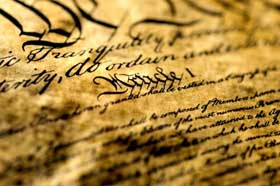
The executive power shall be vested in a President of the United States of America. He shall hold his office during the term of four years,1 and, together with the Vice President, chosen for the same term, be elected....
As with every branch of the United States Constitutional Republic, the Executive Branch has greatly expanded since 1789:
...the President appoints 15 secretaries to preside over 15 executive departments: these individuals are referred to as the Cabinet. Additionally, there are over 60 other executive offices and independent agencies. ...[T]he executive branch supervises all radio and television broadcasting in the U.S., administers nearly 40% of the nation's land area and its resources, oversees a network of health agencies, administers a national welfare program, provides federal relief for victims of natural disasters, supervises the distribution of atomic energy resources, and has a myriad of other responsibilities....2
If the United States Executive Branch were necessary, Yahweh3 would have included it in His law. He did not provide for presidents and vice presidents because He, Himself, is everlasting King:
For YHWH4 is our judge, YHWH is our lawgiver, YHWH is our king.... (Isaiah 33:22)5
Because the constitutional framers did not acknowledge the United States Constitution's subordination to Yahweh and His sovereignty, Article 2 can only be understood as a rejection of Yahweh's executive authority and an attempt to usurp His executive power.
It would be interesting to catalog the consequences of presidential decisions. Most Americans living today (provided they have not been misled by his claim to Christianity) are familiar with some of George W. Bush's Biblical violations. And everyone is aware of Bill Clinton's sins in office. But what of the lives of past presidents? What of George Washington, who is extolled as one of America's greatest Christian6 statesmen? What kind of President was he?
To discuss Washington may seem a departure from this book's primary objective, but because he was a key figure in the Constitutional Convention and the United States' first President, it is important to understand what kind of man he was. We find conflicting contemporary testimony regarding Washington's Christianity. Some say he was a Christian, while others - including his own pastor Dr. James Abercrombie - say he was not. One thing everyone agrees upon is that Washington never made a public confession of Christ as His Lord and Savior:
Whosever therefore shall confess me before men, him will I confess also before my Father which is in heaven. But whosever shall deny me before men, him will I also deny before my Father which is in heaven. (Matthew 10:32-33)6
Washington was indisputably a Freemason:
Washington had served as Grand Master [actually Worshipful Master7] of the Alexandria [Virginia] lodge in 1788 and 1789. When he was inaugurated President of the U.S., he was therefore a Grand [Worshipful] Master, the only Mason to be inaugurated President while serving as a Grand [Worshipful] Master....
As President, he ... never wavered in his attachment to Masonry. ...Washington wrote: "Being persuaded that a just application of the principles, on which the Masonic Fraternity is founded, must be promotive of private virtue and public prosperity, I shall always be happy to advance the interests of the Society, and to be considered by them as a deserving brother."....
John Eidsmoe, in his book-length attempt to defend the Constitution as a Christian document, takes seriously Washington's outright lie - it can be nothing else - in a letter to G.W. Snyder in 1798, that he had not been in a Masonic lodge "more than once or twice in the last thirty years." One does not become the Grand [Worshipful] Master of a lodge by attending services once or twice over thirty years, but one can certainly fool two centuries of Christian critics by lying through one's wooden teeth about it.8
Washington, although hardly a Christian, was a Freemason of the rankest sort. "Testimony given by Timothy Bigelow in a eulogy before the Grand Lodge of Massachusetts two months after Washington's death indicates that Washington's Masonic experience was more than perfunctory."9:
The information received from our Brethren who had the happiness to be members of the Lodge over which he presided for many years, and of which he died the Master, furnishes abundant proof of his persevering zeal for the prosperity of the Institution. Constant and punctual in his attendance, scrupulous in his observance of the regulations of the Lodge, and solicitous, at all times, to communicate light and instruction, he discharged the duties of the chair with uncommon dignity and intelligence in all the mysteries of our art.10
In Founding Fathers, Secret Societies, Robert Heironimus reported:
In his letters and addresses to Masonic bodies, Washington repeated his profound esteem for their principles. In 1797, he addressed the Grand Lodge of Massachusetts: "My attachment to the Society of which we are all members will dispose me always to contribute my best endeavors to promote the honor and prosperity of the Craft."11
What about the other framers frequently referred to as great Christians?
It is difficult for modern Americans to recapture the religious spirit of the country's great early leaders - George Washington, Thomas Jefferson, Benjamin Franklin, and their colleagues. The difficulty arises because these brilliant leaders, surely the most capable generation of statesmen ever to appear in America, were at once genuinely religious but not specifically Christian. Virtually all these great men had a profound belief in ‘the Supreme Judge of the world' and in ‘the protection of Divine Providence,' to use the words of the Declaration of Independence. Yet only a few believed in the orthodox teachings of traditional Christianity - that, for example, Christ's death atoned for sin, that the Bible was a unique revelation from God, or that the miracles recorded in the Scripture actually happened.12
Twenty-eight of the forty constitutional signers were Freemasons or had Masonic connections. Sixteen presidents and thirty-five Supreme Court Justices were Freemasons, the most notable being Chief Justice John Marshall (1801-1835), reputed to be the "Father of the Judiciary" and the "Great Expounder of the Constitution." Marshall served as Grand Master of the Virginia Masons from 1793 to 1795.
Freemason Sovereign Grand Commander Henry C. Clausen, in his book Masons Who Helped Shape Our Nation (commissioned for the Declaration of Independence's bicentennial), maintained that the Constitution was fashioned after Masonic government:
...Freemasonry set the pattern in ideology and form. Since the Masonic federal system of organization was the only pattern for effective organization operating in each of the original Thirteen Colonies, it was natural that patriotic Brethren intent on strengthening the fledgling nation would turn to the organizational base of the Craft for a model. Regardless of the other forces that affected the formation of the Constitution during the Constitutional Convention in 1787, the fact remains that the federalism established in the civil government the Constitution created is identical to the federalism of the Grand Lodge system of Masonic government created in Anderson's Constitutions of 1723. In purpose as well as in form, the Constitution reflects Masonic influence. Freedom, justice, equity and fraternity are the four cornerstones of the symbolic Temple of Freemasonry, and the Constitution reveals these ideals in many phrases. 13
The United States Capitol was built according to Masonic rituals:
On the 15th day of April, 1791, the Hon. Daniel Carroll and Dr. David Stewart superintended the fixing of the first corner-stone of the District of Columbia, at Jones's Point, near Alexandria, where it was laid with all the Masonic ceremonies usual at that time.... On the 18th of September, 1793, the southeast corner-stone of the Capitol was laid by [President] Washington, with Masonic and Christian services and military demonstrations....14
David Barton minimizes the framers' Masonic connections (as do nearly all Christian Constitutionalists), pointing out that there were differences between the Masonry of their day and our own. Masonry has evolved, but not enough to dismiss the framers' Masonic connections. Many of Freemasonry's most disconcerting aspects (many of which were borrowed from the antichristian Babylonian Talmud15) were in full force in the framers' day: its self-maledictory oaths (not to Yahweh, His Word, or Christianity, but to the Masonic fraternity), its toleration of polytheism, its secular and humanist ethics, and its promotion of gender equality:
The Freemasonry of the 1700's is still basically the same [as that of today]. The concept of the Enlightenment period has not changed. What Masons of that day believed, so do the Masons of today. Freemasonry was not radically different.... [A]nti-Masons ... cannot ... explain why such great men as Washington, Lafayette and Paul Revere were members. ...the basic beliefs of the fraternity are the same.16
Freemasons do not meet the criteria of true Christians:
Of course Christians can pray in lodge! What they may not do is offer a specifically Christian prayer as Lodge prayer, any more than a Jew or Muslim may offer a prayer specific to his religion. The reason for this is that it is the custom of Masonry to require all to participate and assent to Lodge prayer. How can it be proper for a Christian to require non-Christians to assent to a prayer peculiar to his own peculiar belief? No Christian would assent to a prayer offered by a Jew or Muslim which essentially denied the doctrine of the trinity. Because Lodge acts in unison, prayers offered in Lodge must be of a nature that will be agreed to by all.
To be sure, some Christians believe that only prayers given in a particularly Christian form are truly prayers. These people cannot become Freemasons because they do not subscribe to the principles of religious toleration required of Masons.17
In other words, any "Christian" Freemason, such as Washington, had to reject Christ's exclusionary declaration in order to be a Freemason:
Jesus saith unto him, I am the way, the truth, and the life: no man cometh unto the Father, but by me. (John 14:6)That Freemasons and antichrists, such as Washington and Jefferson (who cut the virgin birth, miracles, resurrection, and ascension of Christ - what he described as a "dunghill" - out of his cut-and-paste New Testament18), could be elected President speaks volumes of the non-Christian character of the Constitution.19
The Framers at the Constitutional Convention issued a death warrant against Christianity, but for tactical reasons, they and their spiritual heirs refused for several generations to deliver it to the intended victims. They covered this covenantal death sentence with a lot of platitudes about the hand of Providence, the need for Morality, the grand design of the universe, and similar Masonic shibboleths. 20
Even if some of the framers were genuine Christians, they doomed their divided house to eventual destruction when they unequally yoked themselves with those who were not Christians. George Washington's involvement with Freemasonry is only the beginning of presidential transgressions. Their sins and impositions upon the American people have grown steadily because the framers refused to believe Psalm 19:7, Isaiah 33:22, etc.
Presidents, vice presidents, and their tax-paid cabinets and staffs are superfluous. This will initially be difficult to accept for the average American who cannot fathom government without a human executive leader. However, no executive branch except for Yahweh's Kingship existed in America before 1788. The nation functioned without a president and vice president:
Their [the Puritans'] form of government was as strictly theocratical insomuch that it would be difficult to say where there was any civil authority among them distinct from ecclesiastical jurisdiction. Whenever a few of them settled a town, they immediately gathered themselves into a church; and their elders were magistrates, and their code of laws was the Pentateuch.... God was their King; and they regarded him as truly and literally so....21
An email that began circulating during Barack Obama's presidential campaign asked the question, "Can a Muslim be a good American President?" Thanks to Article 6 and Amendment 1, the answer is "yes" (with the debatable exception of the word "good"). However, the more important question is, can a Christian be a United States President? How can a Christian - whose allegiance is to Yahweh alone - swear to uphold a Constitution adversarial to His morality as found in His commandments, statutes, and judgments? How can a Christian impartially represent WE THE PEOPLE, the vast majority of whom are indifferent or antagonistic to Yahweh, His kingdom, and His will? How can a Christian preside over a government that promotes pluralism, polytheism, infanticide, sodomy, and multiculturalism?
Blessed is the man that walketh not in the counsel of the ungodly, nor standeth in the way of sinners, nor sitteth in the seat of the scornful. But his delight is in the law of YHWH; and in his law doth he meditate day and night. (Psalm 1:1-2)
When today's Christians finally re-establish Yahweh's government (as in the days of the Puritans), the only executive branch will be the one described in Isaiah 33:22, in which Yahweh is King and His judges adjudicate according to His law.
Article 2 provides four-year terms for presidents. Amendment 22 limits presidents to two terms. Most people would concede term limits are a good thing when evil men rule. But the question Christians should be asking is whether term limits are Biblical. Consider Solomon's wisdom:
For the transgression of a land many are the princes thereof: but by a man of understanding and knowledge the state thereof shall be prolonged. (Proverbs 28:2)
Yahweh intends the term of a ruler who keeps His law to be protracted:
And it shall be, when he sitteth upon the throne of his kingdom, that he shall write him a copy of this law in a book ... that he turn not aside from the commandment, to the right hand, or to the left: to the end that he may prolong his days in his kingdom.... (Deuteronomy 17:18-20)
The Constitution provides that the United States be ruled by ruler after ruler, which is part of Yahweh's judgment against our sinful nation. Although term limits prevent corrupt officials from serving any longer than their terms allow, they permit them to serve as long as their terms allow. Term limits are a Band-Aid on a self-inflicted wound. Under Yahweh's law, provided a man remains Biblically qualified and mentally capable, he would not need to be removed from his bench. Only when a judge - for whatever reason - becomes Biblically unfit, should his term end.
...the community put the legislative power into such hands as they think fit....John Locke22
Article 2 provides for the election of presidents. Voting has for so long been promoted as one of the United States' foundational and inviolable rights that it is sacrosanct to most Americans. To question the legitimacy of elections is almost tantamount to sedition - even in the eyes of the average Christian. Many Christians contend that voting is a god-given right, and it is a right - under the god WE THE PEOPLE. Regrettably, even pronomian and anti-Constitutional author Gary North promotes elections and juries as if they are Biblically ordained activities:
God's civil covenant places judicial boundaries around the voting booth, the jury room, and civil magistrate's office. To violate these boundaries is to commit revolution or treason against God.23
It is true that Yahweh has placed judicial boundaries around the civil magistrate's office, as demonstrated in the list of Biblical qualifications provided later in this chapter. However, in order for judicial boundaries to surround the voting booth and the jury room, Yahweh's civil covenant must first offer a Biblical mandate for the voting booth and the jury room. Yahweh offers no such mandates. (See Chapter 6 "Article 3, Judicial Usurpation" for information regarding the unbiblical nature of juries.)
North later declared that "biblical theocracy in every area of life can and should come through majority vote or acceptance."24 This presumption theoretically puts Yahweh and His government under the control of a non-Christian majority until enough people can be won to Christ and taught His laws. Of course, these Christians must then vote in a majority bloc, hopefully for the right men. The Bible offers no record of Yahweh ever using a majority vote to establish His government.
North also stated, "Christians may vote either liberal or conservative, Democratic or Republican, but they must ... vote biblical."25 This sounds like a good idea, but who was the last liberal, conservative, Democrat, or Republican who was Biblical? Christians who are Biblical do not vote.
Any government that fails to promote Yahweh's kingdom is a rival, and even hostile, kingdom that Yahweh intends to abolish (Isaiah 9:6-7, Daniel 2:37-44, etc.).
No matter what the form of government is, the Bible doesn't advocate anything but a theocracy. Any [other] form of government is going to self destruct because you're dealing with corrupt people....26
If left to themselves and their inherently flawed laws and policies, the leaders of men's governments will inevitably become more and more ungodly, leading to the ultimate destruction of the governments they represent:
Shall the throne of iniquity have fellowship with thee, which frameth mischief by a law?... And he [Yahweh] shall bring upon them their own iniquity, and shall cut them off in their own wickedness; yea, YHWH our God shall cut them off. (Psalm 94:20, 23)
Ironically, short-sighted Christians are found resisting and even contesting Yahweh's objective. They want to intervene and "save" the competing kingdom by electing "better" men into office. As a result, the demise of the competing kingdom is prolonged, and, in the practical sense, Yahweh's kingdom here on earth is postponed that much longer.
Christians may be praying for Yahweh's will and kingdom here on earth as it is in heaven, but by voting for their "better" man, they are promoting and toiling for a rival kingdom. If you are a Christian who participates in unbiblical elections, the best thing you can do for Yahweh's kingdom is to vote the worst candidate into office. The quicker this government falls, the quicker Yahweh's government can be reinstated.
Because Americans are inundated with propaganda declaring it unpatriotic not to vote, the recommendation that Christians not participate in elections is often met with hostility. Are we more concerned about being un-American or being unbiblical?
In addition to the continual brainwashing about how fortunate we are to have free elections, one of the reasons most Christians believe so strongly about protecting their right to vote is few of them have ever challenged elections from a Biblical paradigm. Some people attempt to use Jethro's counsel to his son-in-law Moses as the Biblical precedent for elections:
Moreover thou shalt provide out of all the people able men, such as fear God, men of truth, hating covetousness; and place such over them, to be rulers of thousands, and rulers of hundreds, rulers of fifties, and rulers of tens. (Exodus 18:21)
What is described here was not a popular election; it was a nomination of qualified men for Moses to appoint. An election is not necessary to select Biblically qualified men. Men either are Biblically qualified or they are not. Popularity determines elections; Biblical qualifications determine appointments. To assume Jethro's instructions called for elections is just that - an assumption. Jethro's counsel called for the appointment of rulers (elders) who would be judges, not the election of men or women who would be presidents. Among other things, an appointed leader must:
- Be a man.27
- Be a Christian.28
- Be an Israelite.29
- Fear Yahweh, not man.
- Be schooled in Yahweh's law.
- Write out his own copy of Yahweh's law.
- Read Yahweh's law daily.
- Observe Yahweh's law in his own life.
- Be humble.
- Be honest.
- Be just.
- Be impartial in judgment.
- Be immune to bribery.
- Be neither greedy nor covetous.
- Be a terror to the wicked and a champion of the righteous. 30
Even if a man meets all of these qualifications, he still may be ineligible if his wife and children fall short. A judge must be the head of his own home and have a dignified, non-gossiping, sober, faithful wife and faithful, submissive children. In Romans 13, the Apostle Paul describes such men as "ministers [servants] of God to thee for good." This is not a description of politicians provided through elections, regardless their political affiliation.
Despite their promotion of elections, a few 18th-century men, Noah Webster among them, understood the importance of having godly men as rulers over society:
...let it be impressed on your mind that God commands you to choose for rulers just men who will rule in the fear of God. ...[I]f the citizens neglect their duty and place unprincipled men in office, the government will soon be corrupted; laws will be made not for the public good so much as for selfish or local purposes; corrupt or incompetent men will be appointed to execute the laws; the public revenues will be squandered on unworthy men; and the rights of the citizens will be violated or disregarded. If a republican government fails to secure public prosperity and happiness, it must be because the citizens neglect the Divine commands and elect bad men to make and administer the laws.31
In other words, a Republican government's only hope of success is if a minority of Christians (Matthew 7:14) are somehow elected by a majority of non-Christians (Matthew 7:13).
It is better to trust in YHWH than to put confidence in man. It is better to trust in YHWH than to put confidence in princes. (Psalm 118:8-9)
Helen Keller once said, "We vote, what does that mean? It means that we choose between two bodies of real, though not avowed, autocrats. We choose between Tweedledum and Tweedledee."32 The election process has not only programmed Americans to put their trust in "princes," but to accept the lesser of two evils. Or is it the evil of two "lessers"? That this is true of most Christians was demonstrated in the 2008 Presidential election:
At a meeting Tuesday [July 1, 2008] in Denver, about 100 conservative Christian leaders ... agreed to unite behind the candidacy of John McCain, a politician they have long distrusted.... Phil Burress ... said ... "I was once one of those people who said ‘no way' to Sen. John McCain as President. No longer, the stakes are too high. And if Obama wins I need to be able to get up on November 5th, look at myself in the mirror, and when I pray, say, ‘Lord, I did all that I could."33
"The alternative is so bad we must support John McCain," said Phyllis Schlafly.... One participant said he couldn't imagine anything worse. "Obama has done the impossible," he said, "He's made Hillary Clinton look good to Christian conservatives."34
This occurred because - unlike Yahweh's system, which provides for the appointment of the best of the best - the Constitution compels people to (hopefully) elect the best of the worst. It also necessitates political parties that are not only unbiblical but whose platforms are invariably ungodly. Political parties are the mechanism by which Christian constituents are offered up on the altar of WE THE PEOPLE.
After every election, regardless who's elected, Americans eventually have cause for regret (Proverbs 29:2). And yet, every four years, they march right back to the voting booths with eternal hope (or is it merely short-sightedness?) and do it all over again. Elections provide us with a lose-lose proposition. On the other hand, when we have two or more Biblically qualified candidates, we end up with a servant of God, regardless who's appointed.
Gary DeMar claimed, "We see democracy in the election of Israel's kings (Deuteronomy 17:14-20)."35 Nothing could be further from the truth:
When thou art come unto the land which YHWH thy God giveth thee, and shalt possess it ... and shalt say, I will set a king over me ... thou shalt in any wise set him king over thee, whom YHWH thy God shall choose.... (Deuteronomy 17:14-15)
In verse 15, the Israelites were instructed to select leaders predicated upon "whom YHWH thy God shall choose." Verses 9 and 10 specify the same for judges. But how do we determine Yahweh's choice? This is accomplished by casting lots, just as the eleven apostles did in Acts 1:
And they appointed two, Joseph called Barsabas ... and Matthias. And they prayed, and said, Thou, Lord, which knowest the hearts of all men, shew whether of these two thou hast chosen, that he may take part of this ministry and apostleship.... And they gave forth their lots; and the lot fell upon Matthias; and he was numbered with the eleven apostles. (Acts 1:23-26)
Although Yahweh had revealed to Samuel His choice of Saul as Israel's first king, in 1 Samuel 10, He used lots to make known His choice to the people:
And when Samuel had caused all the tribes of Israel to come near, the tribe of Benjamin was taken [by lots]. When he had caused the tribe of Benjamin to come near by their families, the family of Matri was taken, and Saul the son of Kish was taken... And Samuel said to all the people, See ye him whom YHWH hath chosen.... (1 Samuel 10:20-24)
By praying and casting lots, we put the decision in the hands of Yahweh, who looks to the heart of each man:
...YHWH seeth not as man seeth; for man looketh on the outward appearance, but YHWH looketh on the heart. (1 Samuel 16:7)
Before lots are thrown, a man must first aspire to the position of judge (1 Timothy 3:1). An opportunity would then be presented to the brethren to raise objections regarding his Biblical qualifications. If no one raises legitimate objections, the man's name is put forward with other qualified candidates, and, following prayer, lots are thrown so Yahweh's choice may be determined.
The lot is cast into the lap; but the whole disposing thereof is of YHWH. (Proverbs 16:33)
The lot causeth contentions to cease, and parteth [decides, NASB] between the mighty. (Proverbs 18:18)
In Contending for the Constitution, Mark Beliles and Douglas Anderson quote John Jay, who in a futile attempt to make elections Biblical, distorts Yahweh's means of selection:
The freedom to choose one's representatives is not an American invention, but a Divine plan for godly government.... John Jay, author of a portion of the Federalist Papers and the country's first Chief Justice of the Supreme Court, made this observation: "Providence has given to our people the choice of their rulers, and it is the duty as well as the privilege and interest of our Christian nation to select and prefer Christians for their rulers."36
Jay's statement contains two glaring errors. First, as we have already seen in Deuteronomy 17:15, Providence (Yahweh) has not given the people the choice (election) of their rulers. Yahweh requires we appoint the man He chooses. Secondly, under the New Covenant, Yahweh does not prefer Christians, He demands Christians as rulers (judges) in His government (Romans 13:3-4, 1 Corinthians 6:1-5, etc.).
By Yahweh's means of appointment, man does the selecting and Yahweh does the electing. The term "election" is actually a Biblical expression, referring to Yahweh's choice of leaders. Man has hijacked the term and replaced Yahweh's means of election with his own, by which (we hope) the better man, rather than Yahweh's best man, is chosen.
The Constitutional Republic's surrogate election process is essentially no different from what occurred in Numbers 14 after the Israelites refused to go in and take possession of the land of Canaan. Verse 4 informs us that they clamored for a leader of their own choosing. Nehemiah 9:17 aptly depicts their substitute plan: "[The Israelites] refused to obey ... but hardened their necks, and in their rebellion appointed a captain to return to their bondage...." History has demonstrated that the Constitutional Republic's election process has produced spiritual, political, and economic bondage for Americans. Simply put, with men's elections we lose, and with Yahweh's elections we win.
As subjects of the King of kings, our duty is not to elect a candidate from a political party (including, and perhaps especially, the Constitution Party). Our duty is to establish Yahweh's judicial system and appoint men who fear Him and who will enforce His law rather than constitutional law.
Voters become accomplices to the crimes of those they elect. Paul warned Timothy of one of the consequences of impulsive appointments:
Do not lay hands upon anyone too hastily and thus share responsibility for the sins of others; keep yourself free from sin. (1 Timothy 5:22, NASB)
Two verses later, Paul warned that "the sins of some men are quite evident, going before them to judgment; for others, their sins follow after." Because no man can look into the heart of another man, voters often do not know what sins they are participating in until after the election - often long after the election. For example, on August 4, 2010, Chief U.S. District Judge Vaughn R. Walker overturned California's Proposition 8, known as "California's Marriage Protection Act," (which declares that "only marriage between a man and a woman is valid or recognized in California"), paving the way for sodomites like himself to "marry" one another. Vaughn was appointed to the bench in 1989 by President George H.W. Bush. Christians who helped elect the "conservative" Bush into office are therefore accomplices to this wickedness.
Elections embody an even more inherent evil. Namely, to be a viable god, WE THE PEOPLE must demonstrate power in some fashion. How is this accomplished? The power of most false gods resides in the minds of those who worship them. With the deity WE THE PEOPLE, however, the people are able to demonstrate actual power. The word "democracy" is derived from the Greek words demo, meaning "people" and kratos, meaning "power". Democracy literally means "people power." This people power is constitutionally demonstrated in two ways: through elections and juries. Through these two means, WE THE PEOPLE finds its voice and becomes a viable god, in defiance of Yahweh:
There could ultimately be no appeal beyond the sovereign will of the voters. The People as a collective unit are best represented by the voters. The People collectively are originally sovereign ... ultimately the voters are sovereign. The People speak through the voters.37
Some people protest that the United States government is not a democracy but a republic. There is little difference between the two:
democracy ... 1. a government by the people; a form of government in which the supreme power is vested in the people and exercised directly by them or by their elected agents under a free electoral system....38
republic ... 1. a state in which the supreme power rests in the body of citizens entitled to vote and is exercised by representatives chosen directly or indirectly by them....39
Republicanism is just another form of people power, expressed through a majority vote. Vox populi vox dei ("the voice of the people, the voice of god") is the rallying cry of the Constitution, republicanism, democracy, and humanism. What happened to the rallying cry of the American revolution - "no king but Jesus"?
Constitutionalists often contrast the divine right of kings with the divine right of the people:
King Charles II beheaded Algernon Sidney in 1683 for saying that there is no divine right of kings to rule over the people. Sidney insisted that the right to rule is actually in the people and therefore no person can rightfully rule the people without their consent [or vote].40
The only difference between the divine right of kings and the divine right of the people is the number of people involved. Whether ruled by one or many, it is still humanism. The "divine right" of the people to elect whomever they wish replaced not only the divine right of kings and parliament, but also the divine right of Yahweh as God, King, Judge, and Lawgiver. James Wilson, one of Pennsylvania's delegates to the Constitutional Convention, labeled this divine attribute "sovereignty":
Election is the exercise of original sovereignty in the people....41
There is only one Sovereign and it is certainly not the people:
...He who is the blessed and only Sovereign, the King of kings and Lord of lords.... (1 Timothy 6:15, NASB)
In a Born Loser cartoon by Art and Chip Sansom, Brutus Thornapple asks a bum at the bus stop, "Have you decided who you're going to vote for in the election?" The bum replies, "Oh, I never vote; I find it only encourages them." It not only encourages them, it empowers them. Participating in elections is participating in sedition against Yahweh.
Most Christians do not understand the Biblical ramifications of elections, particularly concerning their part in the selection of "legislators." Whoever makes a nation's laws is ultimately the god of that nation. If only Christians were elected, but they still enacted laws contrary to the Bible (which today's antinomian Christians would inevitably do), they would be just as responsible for enthroning WE THE PEOPLE as are today's non-Christian electorate. Christians, through elections, help determine the direction or course of their communities, states, and nation - but not for the ultimate good. America's voting history demonstrates that elections have produced men and women who are progressively more unbiblical and ungodly.
The Christian electorate inevitably endorses, authorizes, commissions, and empowers the false god WE THE PEOPLE and its kingdom and laws. In every election, Christians put their confidence in a man rather than in Yahweh. Every four years, most "conservative" Christian ministries encourage their flocks to empower the false deity WE THE PEOPLE. Consider the following from Dr. James Dobson:
...let me take a moment to remind you about the national election that is rapidly approaching.... Unfortunately, millions of Christians are unlikely to vote again this year. That is disgraceful!42
Where did Dobson get the authority to say it is disgraceful to reject participation in the election process? Dr. Rick Scarborough of Vision America took it one step further when he declared, "For a Christian not to vote is a sin."43 According to 1 John 3:4, sin is a transgression of Yahweh's law. Which of Yahweh's laws requires voting? Following is how Kenneth Copeland expressed Christians' responsibility to vote:
As the Body of Christ, we have great authority in the kingdom of heaven and in the things of God. It may come as a shock to many to learn that even though politicians will have to answer to God for what they do, the Body of Christ will also be held responsible [for not voting]....44
Will the body of Christ answer to Yahweh because they do not participate in the election process? In view of the unbiblical implications of elections, Christians will more likely be judged for their involvement. Copeland intensified the guilt with the mantra "people have suffered and died so we could have that right [to vote]."44 Has there been even one military conflict since the ratification of the Constitution in which American citizens' right to vote was in jeopardy? Voting was not an issue even in America's War for Independence, fought thirteen years before the Constitutional Convention. Copeland went on to say, "not voting is the same as casting a vote for the wrong side."44 Because not all Christians vote for the same candidate, some of those who vote "vote for the wrong side." In reality, to participate in elections is to vote against Yahweh and His kingdom.
How about "voting out all the rascals" as some people suggest? Even if this were plausible, it would only result in a new batch of rascals who would need voting out in the next election. We cannot fix the system by perpetuating the system. We cannot bring about Yahweh's kingdom here on earth by voting the opposition into office - regardless their merits. In the end, elections are a political shell game that diverts the attention of the people from the real solution. Copeland audaciously continued:
Your Holy Spirit-directed ballot is a powerful seed. When you vote in faith, in obedience to God, your household will be protected. God will take care of you no matter who is in office or what is happening in the world. So don't fear.44
What is a "Holy Spirit-directed ballot"? How can it be directed by the Holy Spirit when not all Christians cast the same vote? Would this not make the Holy Spirit double-minded? The result of Christian voting is more likely to be a fulfillment of Jesus'45 declaration in Matthew 12:25 that "every kingdom divided against itself is brought to desolation; and every city or house divided against itself shall not stand."
Copeland claimed that if Christians vote, their households will be protected. How does he justify this to the parents who elected George W. Bush and then lost their sons and daughters in the ungodly conflicts in Iraq and Afghanistan?
Even pronomians often promote voting for constitutional candidates, sometimes without any mention of Christian principles or even a Biblical caveat:
Christians must elect representatives who will abide by the Constitution, not only in word but in deed. All candidates running for public office should be required to take a comprehensive test on the Constitution with the results of the test published so all can see that they really know and understand the Constitution they will swear to uphold.46
It is difficult for me to imagine any Christian endorsing candidates who would abide by a document antithetical to Yahweh's morality and antagonistic to His sovereignty. Instead, appointees should be considered and tested based upon Biblical qualifications.
In an article entitled "Hold Your Nose and Vote," Lenny Cacchio summarized many Christians' position, "Until the kingdom of God comes, we must suffer the fools and be grateful for the occasional statesman." He added, "I have accepted that this is the way of the world, a mixture of desirable and undesirable traits of fallible humans. And I know that is the way it will be until the King of kings decides it is time to change it."47 Here we have the crux of the problem: Christians have given up conducting their lives Biblically because they are either waiting for the return of their King to make things right or they are waiting for the rapture to whisk them off to heaven. I contend that Yahweh is waiting on us to make things right. After all, we are the ones who have made a mess of things.
On November 3, 2004, popular public radio host Garrison Keillor said the following:
I am now chairman of a national campaign to pass a constitutional amendment to take the right to vote away from born-again Christians. Just a little project of mine. My feeling is that born-again people are citizens of heaven; that is where their citizenship is, in heaven, it's not here among us in America.48
This statement was followed by much laughter and applause - and much indignation from Christians. However, real Christians would have concurred with Keillor. Christians have no business participating in elections produced by a system in opposition to Yahweh and His kingdom. Some people will consider this abandoning the nation to Yahweh's enemies. In reality, it is the Christian electorate that is condemning us to non-Christian control in a non-Christian system. America cannot elect her way out of her problems; she must repent her way out.
Rather than playing the shell game every few years, Christians should put the same effort and money into establishing Yahweh's kingdom here on earth. One of the principal means of doing this is helping to educate Christians about their constitutional idolatry.
Before he enter on the execution of his office, he shall take the following oath or affirmation: "I do solemnly swear (or affirm) that I will faithfully execute the office of President of the United States, and will to the best of my ability, preserve, protect and defend the Constitution of the United States."
Thou shalt fear YHWH thy God, and serve him, and shalt swear by his name. (Deuteronomy 6:13)
Supreme Court Justice James Iredell (1790-1799), and some of his contemporaries, believed an oath, regardless whether it was taken in the name of Yahweh, was a "solemn appeal to the Supreme Being."49 However, not everyone at the time the Constitution was framed viewed it the same way. The lack of any mention of Yahweh in the presidential oath was vehemently contested in the State's ratifying conventions. Because the Constitution failed to specify Yahweh in its oaths, few of today's government officials regard oaths in the same light Iredell did. As early as 1796 when oaths still retained an appeal to the Supreme Being, they were already inclusive of gods other than Yahweh, as attested by United States Representative Zephaniah Swift:
All persons who believe in the existence of a God, let their religion be what it will, may be admitted to be witnesses. An oath is a solemn appeal to the Supreme Being that he who takes it will speak the truth, and an imprecation of His vengeance if he swears false.50
This polytheistic inevitability was the consequence of Amendment 1's freedom of religion provision. In 1844, Daniel Webster testified before the Supreme Court regarding the pluralism of constitutional oaths:
What is an oath? ...[I]t is founded on a degree of consciousness that there is a Power above us that will reward our virtues or punish our vices.... We all know that the doctrine of the ... law is that there must be in every person who enters court as a witness, be he Christian or Hindoo, there must be a firm conviction on his mind that falsehood or perjury will be punished either in this world or the next or he cannot be admitted as a witness.51
Because the presidential oath does not appeal to Yahweh, it is essentially atheistic. It contains nothing by which presidents can be held to their word:
The oath of the President of the United States could as well be taken by a pagan or a Mahammedan [sic] as by the Chief Magistrate of a Christian people: it excludes the name of the Supreme Being. Indeed, it is negatively atheistical, for no God is appealed to at all. In framing many of our public formularies, greater care seems to have been taken to adapt them to the prejudices of the infidel few than to the consciences of the Christian millions. In these things the minority in our country has hitherto managed to govern the majority. We look on the designed omission of it [the name of God] as an attempt to exclude from civil affairs Him who is the governor among the nations.52
On November 26, 1873, at the National Convention to amend the Preamble, Pastor E.R. Craven noted the following:
On Tuesday next another inauguration is to take place. President Grant may, if he so choose, appeal to God; but even as he takes the oath required, he may proclaim himself an atheist, and there is no power on earth that can stay his inauguration. The Constitution does, in terms, require an oath, but by the proviso quoted it degrades it to the low platform of a solemn promise - the oath that it requires is emasculated.53
Nearly all of the presidents have taken their oath of office by placing their hands upon a Bible. But this empty tradition is nowhere required in the Constitution. Even if this custom were spiritually significant for some of the presidents, it was a meaningless ritual for the majority of them. How could swearing upon a Christian Bible be meaningful to these men when Christianity itself means nothing to them?
Swearing upon the Bible is an empty gesture for an even more important reason. If ever there were an unequal yoking, it is when public officials place their hands on the Bible and swear to uphold the laws of WE THE PEOPLE. This no more Christianizes the oath than Aaron's naming the golden calf "Yahweh" sanctified his idolatry. The Bible offers no precedent for swearing to uphold any other law than Yahweh's. Swearing in Yahweh's name, or swearing on the Bible, means nothing to Him if you simultaneously swear to keep the laws of another god. This is treason and sedition against the God of gods and King of kings.
Be ye therefore very courageous to keep and to do all [commandments, statutes, and judgments] that is written in the book of the law of Moses, that ye turn not aside therefrom to the right hand or to the left; that ye come not among these nations ... neither make mention of the name of their gods, nor cause to swear by them, neither serve them, nor bow yourselves unto them: But cleave unto YHWH your God.... (Joshua 23:6-8)
In order to be Biblical, an oath must be sworn in Yahweh's name:
Thou shalt fear YHWH thy God; him shalt thou serve, and to him shalt thou cleave, and swear by his name. (Deuteronomy 10:20)
This oath necessitates that only those who fear, serve, and cling to Yahweh are qualified to hold leadership positions in Yahweh's government. No greater oath exists than this:
...when God made promise to Abraham, because he could swear by no greater, he sware by himself. (Hebrews 6:13)
The restriction in Article 6 that "no religious test shall ever be required as a qualification to any office or public trust under the United States" eliminates any possibility that this oath might be required for civil leadership. The national constraints against Christian qualifications in Article 6 eventually led to the nullification of all state oaths to the contrary.
Swearing in Yahweh's name places a person under Yahweh's jurisdiction and judgment:
For men swear by one greater than themselves, and with them an oath given as confirmation is an end of every dispute. (Hebrews 6:16, NASB)
In order for such an oath to end every dispute, it must be self-maledictory - that is, one in which the person calls down a curse upon himself if he does not uphold his oath. An example of a self-maledictory oath can be found in Nehemiah 10:
...their nobles ... entered into a curse, and into an oath, to walk in God's law ... and to observe and do all the commandments of YHWH our Lord, and his judgments and his statutes.... (Nehemiah 10:29-30)
Unlike the vast majority of oaths, which are broken whenever it is advantageous, the oaths taken in Nehemiah's day actually meant something. Maledictory oaths taken in the name of Yahweh place the oath taker under the curse of Yahweh if he does not uphold his oath:
An outward pledge given by the person taking it that his attestation or promise is made under an immediate sense of his responsibility to God.... The term has been variously defined: as, "a solemn invocation of the vengeance of the Deity upon the witness if he do [sic] not declare the whole truth, so far as he knows it;" ... or "religious asseveration by which a person renounces the mercy and imprecates the vengeance of Heaven if he do not speak the truth" ... or "a religious act by which the party invokes God not only to witness the truth and sincerity of his promise, but also to avenge his imposture or violated faith, or ... to punish his perjury if he shall be guilty of it;".... The essential idea of an oath would seem to be, however, that of a recognition of God's authority by the party taking it, and an undertaking to accomplish the transaction to which it refers as required by his laws.54
So solemn and awful were all appeals to God considered in those ancient times, that it was taken for granted that the man was innocent who could by an oath appeal to the omniscient God that he had not put his hand to his neighbour's goods [Exodus 22:10-11]. Since oaths have become multiplied, and since they have been administered on the most trifling occasions, their solemnity is gone, and their importance little regarded.55
The solemnity and consequence of the oath have been lost because its judgment is no longer enforced. As a transgression of the Third Commandment, breaking an oath made in the name of Yahweh is punishable by death.56
And ye shall not swear by my name falsely, neither shalt thou profane the name of thy God: I am YHWH. (Leviticus 19:12)
And he that blasphemeth the name of YHWH, he shall surely be put to death, and all the congregation shall certainly stone him: as well the stranger, as he that is born in the land.... (Leviticus 24:16)
Oaths that do not force us to answer to someone greater than ourselves are impotent. In the event that the oath taker is not a man of his word, something must compel him to uphold his pledge. Cole v. Richardson noted that without self-imprecation, an oath becomes merely an "amenity."57 The presidential oath of office contains nothing compelling or binding. Nothing prevents a president from disregarding his oath the moment he steps off the inauguration platform.
The President shall be commander in chief of the army and navy of the United States, and of the militia of the several states, when called into the actual service of the United States; he may require the opinion, in writing, of the principal officer in each of the executive departments, upon any subject relating to the duties of their respective offices, and he shall have power to grant reprieves and pardons for offences against the United States, except in cases of impeachment.
The President of the United States has the unrestrained power of granting pardons for treason (Art 2, Sect 2, Clause 1); which may be sometimes exercised to screen from punishment those whom he had secretly instigated to commit the crime, and thereby prevent a discovery of his own guilt.George Mason58
This could have been written with George W. Bush in mind. On July 2, 2007, he commuted Scooter Libby's prison term after Libby was convicted in the CIA identity leak of Valerie E. Wilson, aka Valerie Plame. During his two-term administration, Bush granted 191 pardons and nine commutations of people condemned as criminals by the United States judicial system.
[The president] shall have power, by and with the advice and consent of the Senate, to make treaties, provided two-thirds of the senators present concur; and he shall nominate, and by and with the advice and consent of the Senate, shall appoint ambassadors, other public ministers and consuls, judges of the supreme court, and all other officers of the United States, whose appointments are not herein otherwise provided for, and which shall be established by law....
What kind of treaties are included in Section 2, and with whom are they made?
While the power to make treaties is general and unrestricted, it is not to be so construed as to destroy the fundamental laws of the land. "A treaty to change the organization of the government, to annihilate its sovereignty, to overturn its republican form, or to deprive it of its constitutional powers, would be void; because it would destroy what it was designed merely to fulfill, the will of the people."59
Under the Constitution, treaties were to be made, not with the will of Yahweh in mind, but the will of the people. If the Constitution were a Biblically compatible document, the framers would have stipulated (as does the Bible) against entering treaties with non-Christian nations:
And ye shall make no league with the inhabitants of this land; ye shall throw down their altars: but ye have not obeyed my voice: why have ye done this? Wherefore I also said, I will not drive them out from before you; but they shall be as thorns in your sides, and their gods shall be a snare unto you. (Judges 2:2-3)
These consequences have always accompanied America's disobedience when she has made treaties with non-Christian nations. Consider the consequences of GATT, NAFTA, the NAU, and other disastrous unbiblical trade agreements. Yahweh is a jealous God, and He does not permit His people to covenant, contract, or make treaties with individuals or nations that are covenanted with other gods or in rebellion to Yahweh:
And after this did Jehoshaphat king of Judah ... join himself with Ahaziah king of Israel, who did very wickedly: and he joined himself with him to make ships.... Then Eliezer ... prophesied against Jehoshaphat, saying, Because thou hast joined thyself with Ahaziah, YHWH hath broken thy works.... (2 Chronicles 20:35-37)
Christians are warned against participating in the evil deeds of those who reject Christ. The following applies as much to nations as it does to individuals:
For many deceivers are entered into the world, who confess not that Jesus Christ is come in the flesh.... If there come any unto you, and bring not this doctrine, receive him not into your house, neither bid him God speed: For he that biddeth him God speed is partaker of his evil deeds. (2 John 1:7-11)
The provision of Section 2, Clause 2 for the appointment of judges is Biblical. However, with appointments at the discretion of non-Biblical presidents and legislators, such appointments become unbiblical. This is evidenced by the men and women adjudicating in today's constitutional courts, none of whom are Biblically qualified and all of whom judge on behalf of WE THE PEOPLE or create their own laws based upon their own opinions and rulings.
The President, Vice President, and all civil officers of the United States shall be removed from office on impeachment for, and conviction of, treason, bribery, or other high crimes and misdemeanors.
Treason and high crimes against whom? Not against Yahweh. Constitutional government does not recognize high crimes (such as idolatry, blasphemy, and adultery) against Yahweh as crimes at all. If it did, Bill Clinton and other presidents would not only have been impeached, they would have been executed. The treason and high crimes mentioned in this Clause refer only to crimes against WE THE PEOPLE, which further proves that WE THE PEOPLE is the principle god of the Constitutional Republic. If the Constitution were a Biblical document, no presidents could ever be impeached because no presidents and vice presidents would ever be elected.
Click to order the Bible Law vs. The United States Constitution CDs:
- The e-book (on CD) A Christian Perspective on the U.S. Constitution
- The audio CD The Bible vs. The U.S. Constitution (Pts. 1 & 2)
1. Amendment 22, adopted in 1951, limits a president to two four-year terms.
2. Mark A. Beliles, Douglas S. Anderson, Contending for the Constitution: Recalling the Christian Influence on the Writing of the Constitution and the Biblical Basis of American Law and Liberty (Charlottesville, VA: Providence Foundation, 2005) p. 169.
3. YHWH (most often pronounced Yahweh) is the English transliteration of the Tetragrammaton, the principal Hebrew name of the God of the Bible. For a more thorough explanation concerning the sacred names of God, "The Third Commandment" may be read online, or the book Thou shalt not take the name of YHWH thy God in vain may be ordered from Mission to Israel Ministries, PO Box 248, Scottsbluff, Nebraska 69363, for a suggested $4 donation.*
4. Where the Tetragrammaton (YHWH) - the four Hebrew characters that represent the personal name of God - has been unlawfully rendered the LORD or GOD in English translations, I have taken the liberty to correct this error by inserting YHWH where appropriate. For a more thorough explanation concerning the use of the sacred names of God, "The Third Commandment" may be read online, or the book Thou shalt not take the name of YHWH thy God in vain may be ordered from Mission to Israel Ministries, PO Box 248, Scottsbluff, Nebraska, 69363, for a suggested $4 donation.*
5. All Scripture is quoted from the King James Version, unless otherwise noted. Portions of Scripture have been omitted for brevity. If you have questions regarding any passage, please study the text to ensure it has been properly used.
6. Not everyone claiming to be a Christian has been properly instructed in the Biblical plan of salvation. Mark 16:15-16; Acts 2:36-41, 22:1-16; Romans 6:3-4; Galatians 3:26-27; Colossians 2:11-13; and 1 Peter 3:21 should be studied to understand what is required to be covered by the blood of Jesus and forgiven of your sins. For a more thorough explanation concerning baptism and its relationship to salvation, the book Baptism: All You Wanted to Know and More may be requested from Mission to Israel Ministries, PO Box 248, Scottsbluff, Nebraska 69363, for free.
7. Henry C. Clausen, Sovereign Grand Commander, Masons Who Helped Shape Our Nation (San Diego, CA: Neyenesch Printers, 1976) pp. 9-12.
8. Gary North, Political Polytheism: The Myth of Pluralism (Tyler, TX: Institute for Christian Economics, 1989) pp. 422-24.
9. Robert Heironimus, Founding Fathers, Secret Societies: Freemasons, Illuminati, Rosicrucians, and the Decoding of the Great Seal (Rochester, VT: Destiny Books, 2006) p. 44.
10. Albert G. Mackey, Revised Encyclopedia of Freemasonry 3 vols. (New York: Macoy Publishing and Masonic Supply, 1966) vol. 2, p. 1095, quoted in Robert Heironimus, Founding Fathers, Secret Societies: Freemasons, Illuminati, Rosicrucians, and the Decoding of the Great Seal (Rochester, VT: Destiny Books, 2006) p. 44.
11. Heironimus, p. 44, quoting Mackey, vol. 2, p. 1095.
12. Mark A. Noll, Nathan O. Hatch, and George M. Marsden, The Search for Christian America (Westchester, IL: Crossway, 1983) p. 72.
14. Benjamin F. Morris, The Christian Life and Character of the Civil Institutions of the United States (Powder Springs, GA: American Vision, Inc., 2009, originally published 1864) pp. 769-70.
15. For information regarding the antichristian nature of the Babylonian Talmud, God's Covenant People: Yesterday, Today and Forever may be read online, or the book may be ordered from Mission to Israel Ministries, PO Box 248, Scottsbluff, Nebraska 69363, for a suggested $14 donation.*
16. Richard E. Fletcher, Post Grand Master and Executive Secretary of the Masonic Service Association of North America, email, 4 December 2008.
17. Roger Firestone, "Difficult Questions About Freemasonry," http://web.mit.edu/dryfoo/Masonry/Questions/difficult.html.
18. Thomas Jefferson, letter to John Adams, 24 January 1814, Lester J. Cappon, ed., The Adams-Jefferson Letters: The Complete Correspondence Between Thomas Jefferson and Abigail and John Adams (Williamsburg, VA: Institute of Early American History and Culture, 1988) p. 384.
19. For an explanation of the antichristian characteristics of Freemasonry, I recommend The Deadly Deception: Freemasonry Exposed ... by One of its Top Leaders, by Jim Shaw and Tom McKenney and Unveiling Freemasonry's Idolatry by John M. Otis.
21. William Holmes McGuffey, McGuffey's Sixth Eclectic Reader (New York, NY: American Book Company, 1879) p. 225.
22. John Locke, Two Treatises of Government (London, UK: C. & J. Rivington) p. 211.
26. John MacArthur, quoted in Lillian Kwon, "Influential Evangelical: Mideast Uprisings Violate Biblical Command," 21 February 2011, The Christian Post,http://www.christianpost.com/news/influential-evangelical-mideast-uprisings-violate-biblical-command-49086/.
27. See Chapter 28 "Amendment 19: The Curse of Women's Suffrage" for information regarding Yahweh's patriarchal qualification.
28. Not everyone claiming to be a Christian has been properly instructed in the Biblical plan of salvation. Mark 16:15-16; Acts 2:36-41, 22:1-16; Romans 6:3-4; Galatians 3:26-27; Colossians 2:11-13; and 1 Peter 3:21 should be studied to understand what is required to be covered by the blood of Jesus and forgiven of your sins. For a more thorough explanation concerning baptism and its relationship to salvation, the book Baptism: All You Wanted to Know and More may be requested from Mission to Israel Ministries, PO Box 248, Scottsbluff, Nebraska 69363, for free.
29. See Chapter 23 "Amendment 14: First-Birth vs. Second-Birth Citizenship" for the identity of today's Israelites and Chapter 24 "Amendment 15: Color-Blind Voting" for the importance of this qualification.
30. Exodus 18:19-21; Deuteronomy 1:13-17, 17:15-20; 2 Samuel 23:3; 2 Chronicles 19:5-8; Jeremiah 30:21; Romans 13:1-4; 1 Timothy 3:1-13; and Titus 1:5-9.
31. Noah Webster, History of the United States (New Haven, CT: Durrie & Peck, 1832) pp. 336-37.
32. Helen Keller, Ellen Bilofsky, ed., "Letter to Mrs. Grindon, January 12, 1911 published in the Manchester Advertiser, March 3, 1911," To Love This Life: Quotations by Helen Keller (New York, NY: AFB Press, 2000) p. 79.
33. Michael Scherer, "Christian Conservatives Uniting Behind McCain," Swampland: TIME blog, 2 July 2008, 34. "Evangelical Leaders Meet and Decide to Back Sen. John McCain," Charisma, 2 July 2008, http://www.charismamag.com/cms/news/archives/0702081.php.
35. Gary DeMar, Democracy Good and Bad, http://americanvision.org/3806/democracy-good-and-bad/.
36. John Jay, quoted in Mark A. Beliles, Douglas S. Anderson, Contending for the Constitution: Recalling the Christian Influence on the Writing of the Constitution and the Biblical Basis of American Law and Liberty (Charlottesville, VA: Providence Foundation, 2005) p. 213.
37. Gary North, Conspiracy in Philadelphia, The Broken Covenant of the U.S. Constitution (Draper, VA: Nicene Council.com, 2004) p. 269.
38. Random House Webster's College Dictionary, s.v. "democracy" (New York, NY: Random House, Inc., 2000) p. 354.
39. Random House Webster's College Dictionary, s.v. "republic" (New York, NY: Random House, Inc., 2000) p. 1121.
40. W. Cleon Skousen, A Miracle that Changed the World: The 5000 Year Leap (Malta, ID: National Center for Constitutional Studies, 2006) p. 141.
41. James Wilson, Chief Justice of the State of New York and one of New York's delegates to the Constitutional Convention, quoted in Robert Yates "Secret Debates of the Federal Convention of 1787," Secret Proceedings and Debates of the Constitutional Convention 1787, Entered according to Act of Congress in the year 1838 (Hawthorne, CA: Omni Publications, 1986) pp. 160-61.
42. Dr. James Dobson, "Family News from Dr. James Dobson," October 1998.
43. Rick Scarborough, "The Vision Grows" Video, www.visionamerica.us/.
44. Kenneth Copeland, "Pray, Listen & Obey ... Vote!"
45. Yeshua is the English transliteration of our Savior's given Hebrew name, with which He introduced Himself to Paul in Acts 26:14-15. (Jesus is the English transliteration of the Greek Iesous, which is the Greek transliteration of the Hebrew Yeshua.) Because many people are unfamiliar or uncomfortable with Yeshua, I have chosen to use the more familiar Jesus in this book in order to remove what might otherwise be a stumbling block. For a more thorough explanation concerning the use of the sacred names of God, "The Third Commandment" may be read online, or Thou shalt not take the name of YHWH thy God in vain may be ordered from Mission to Israel Ministries, PO Box 248, Scottsbluff, Nebraska 69363, for a suggested $4 donation.* 46. Gary DeMar, "Constitutional Hermeneutics," 10 April 2006, http://americanvision.org/1252/constitutional-hermeneutics/.
47. Lenny Cacchio, "Hold Your Nose and Vote," Living to Win.
48. Garrison Keillor, speech delivered at Chicago's Rockfeller Memorial Chapel, 3 November 2004.
49. James Iredell, member of the U.S. Congress and later Chief Justice of the Supreme Court, 30 July 1788, quoted in The Debates in the Several State Conventions on the Adoption of the Federal Constitution, Jonathan Elliot, ed., 5 vols. (Washington, DC: Jonathan Elliot, 1836) vol. 4, p. 196.
50. Zephaniah Swift, A System of Laws of the State of Connecticut (Windham, CT: John Byrne, 1796) vol. 2, p. 238.
51. Daniel Webster, Mr. Webster's speech in Defence of the Christian Ministry and in Favor of the Religious Instruction of the Young, Delivered in the Supreme Court of the United States, February 10, 1844, in the Case of Stephen Girard's Will (Washington, DC: Gales and Seaton, 1844) p. 43.
52. D.X. Junkin, The Oath, quoted in T.P. Stevenson, Corresponding Secretary of the National Association to Amend the Preamble, "History of the Movement to Secure the Religious Amendment of the Constitution of the United States." Proceedings of the National Convention to secure the religious amendment of the Constitution of the United States: Held in New York, Feb. 26 and 27, 1873 (New York: John Polhemus, Printer, 1873) p. iv.
53. E.R. Craven, Address, Proceedings of the National Convention to secure the religious amendment of the Constitution of the United States: Held in New York, Feb. 26 and 27, 1873 (New York: John Polhemus, Printer, 1873) pp. 18-19.
54. John Bouvier, Bouvier's Law Dictionary: A Concise Encyclopedia of the Law, 3 vols., s.v. "Oath" (Kansas City, MO: Vernon Law Book Company, 1914) vol. 3, p. 2388.
55. Adam Clarke, Clarke's Commentary, 6 vols. (New York, NY: Carlton & Phillips, 1853) vol. 1, p. 413.
56. "The Third Commandment" may be read online, or the book Thou shalt not take the name of Yahweh thy God in vain may be ordered from Mission to Israel Ministries, PO Box 248, Scottsbluff, Nebraska 69363, for a suggested $4 donation.* 57. Cole v. Richardson, 405 U.S. at 685, 92 S.Ct. at 1337; 31 L.Ed.2d 593 (1972).
58. George Mason, The Essential Federalist and Anti-Federalist Papers, ed. David Wootten (Indianapolis, IN: Hackett Publishing Company, 2003) p. 1.
59. Israel Ward Andrews, Andrews Manual of the Constitution (Cincinnati and New York: Van Antwerp, Bragg & Co., 1887) p. 168.
*In keeping with 2 Corinthians 9:7, this ministry is supported by freewill offerings. We are admonished in Matthew 10:8 that “freely ye have received, freely give.” Therefore, we will be pleased to provide you with whatever you need for whatever you can send.