Before examining the United States Constitution and comparing it with Yahweh's1 righteousness as codified in His commandments, statutes, and judgments, we must demonstrate that His laws are the standard by which the Constitution (and everything else) must be judged:
The law of YHWH2 is perfect, converting the soul: the testimony of YHWH is sure, making wise the simple. The statutes of YHWH are right, rejoicing the heart: the commandment of YHWH is pure, enlightening the eyes. The fear of YHWH is clean, enduring for ever: the judgments of YHWH are true and righteous altogether. More to be desired are they than gold, yea, than much fine gold: sweeter also than honey and the honeycomb. Moreover by them is thy servant warned: and in keeping of them there is great reward. (Psalm 19:7-11)3
Most modern-day fundamental Christians4 profess that Yahweh's law is perfect, but few of them believe these verses have any practical value today. Most of today's Christians are antinomian.5 They either believe Yahweh's law has little relevance to the New Covenant Christian or that it has been abolished altogether. 6 What irony! Many Christians identify themselves as New Testament or New Covenant Christians and yet they reject the foundation of the New Covenant:
Behold, the days come, saith YHWH, that I will make a new covenant with the house of Israel, and with the house of Judah. ...[T]his shall be the covenant that I will make with the house of Israel; after those days, saith YHWH, I will put my law in their inward parts, and write it in their hearts; and will be their God, and they shall be my people. (Jeremiah 31:31-33)
According to Jeremiah (and the New Testament author of Hebrews, who quoted Jeremiah's prophecy in Hebrews 8:8-10), under the New Covenant Yahweh's laws would be written on the hearts and minds of His people7 for the purpose of putting them into daily practice. It is impossible to be a New Covenant Christian without pursuing Yahweh's laws both individually and societally.
Selective Hermeneutics
Antinomians quote select New Testament passages, which appear to abolish the laws of Yahweh, while completely ignoring the plethora of New Testament passages that declare Yahweh's laws are inherent to the New Covenant. The tragic consequences of this theology, which pits Scripture against Scripture, are found in the following list.
If you believe the laws of Yahweh have been abolished under the New Covenant, and, as a result, you are not pursuing His laws, you...
- Believe heaven and earth have passed away.
"For verily I say unto you, Till heaven and earth pass, one jot or one tittle shall in no wise pass from the law, till all be fulfilled." (Mathew 5:18)
- Are least in the kingdom of heaven.
"Whosoever therefore shall break one of these least commandments, and shall teach men so, he shall be called the least in the kingdom of heaven: but whosoever shall do and teach them, the same shall be called great in the kingdom of heaven." (Matthew 5:19)
- Are not accomplishing Yahweh's will, are not known by Yahweh, and will never live in His presence.
"Not every one that saith unto me, Lord, Lord, shall enter into the kingdom of heaven; but he that doeth the will of my Father which is in heaven. Many will say to me in that day, Lord, Lord, have we not prophesied in thy name? And in thy name have cast out devils? And in thy name done many wonderful works? And then will I profess unto them, I never knew you: depart from me, ye that work iniquity [anomian - lawlessness]." (Matthew 7:21-23)
- Do not love Jesus.8
"If ye love me, keep my commandments." (John 14:15)
- Do not abide in Jesus' love.
"If ye keep my commandments, ye shall abide in my love...." (John 15:10)
- Do not believe the truth.
"...the truth in the law." (Romans 2:20)
- Are unable to identify sin.
"...by the law is the knowledge of sin." (Romans 3:20)
- Fail to exhibit true faith.
"Do we then make void the law through faith? God forbid: yea, we establish the law." (Romans 3:31)
- Do not believe in what is holy, just, and good.
"Wherefore the law is holy, and the commandment holy, and just, and good." (Romans 7:12)
- Do not believe in what is spiritual.
"For we know that the law is spiritual...." (Romans 7:14)
- Are not living righteously or walking after the Spirit.
"That the righteousness of the law might be fulfilled in us, who walk not after the flesh, but after the Spirit." (Romans 8:4)
- Are carnal and at enmity with Yahweh.
"Because the carnal mind is enmity against God: for it is not subject to the law of God, neither indeed can be." (Romans 8:7)
- Are not pleasing to Yahweh.
"Circumcision is nothing, and uncircumcision is nothing, but the keeping of the commandments of God." (1 Corinthians 7:19)
- Do not believe in Yahweh's goodness.
"But we know that the law is good, if a man use it lawfully." (1 Timothy 1:8)
- Do not believe in the New Covenant.
"For this is the [New] covenant that I will make with the house of Israel after those days, saith the Lord; I will put my laws into their mind, and write them in their hearts...." (Hebrews 8:10)
- Do not know Yahweh.
"And hereby we do know that we know him, if we keep his commandments." (1 John 2:3)
- Are a liar, reject the truth, and do not have the love of God perfected in you.
"He that saith, I know him, and keepeth not his commandments, is a liar, and the truth is not in him. But whoso keepeth his word, in him verily is the love of God perfected: hereby know we that we are in him." (1 John 2:4-5)
- Believe you cannot sin and, therefore, do not need Jesus as your Savior.
"Whosoever committeth sin transgresseth also the law: for sin is the transgression of the law." (1 John 3:4)
- Do not love the children of Yahweh.
"By this we know that we love the children of God, when we love God, and keep his commandments." (1 John 5:2)
- Do not love Yahweh.
"For this is the love of God, that we keep his commandments: and his commandments are not grievous." (1 John 5:3)
- Are not a part of Yahweh's New Covenant remnant.
"And the dragon was wroth with the woman, and went to make war with the remnant of her seed, which keep the commandments of God, and have the testimony of Jesus Christ." (Revelation 12:17)
- Are not one of Yahweh's saints.
"Here is the patience of the saints: here are they that keep the commandments of God, and the faith of Jesus." (Revelation 14:12)
- Have no right to the tree of life.
"Blessed are they that do his commandments, that they may have right to the tree of life, and may enter in through the gates into the city." (Revelation 22:14)
Under Law or Under Grace
None of this is to say that Christians are under the law as were the Israelites during the Old (or Mosaic) Covenant. The Bible is very clear that New Covenant Christians are not under the law, but under grace (Romans 6:14). We are no longer required to perfectly keep all of Yahweh's moral laws and additional Old Covenant ordinances for righteousness as were the Israelites under the Mosaic Covenant:
And YHWH commanded us [Old Covenant Israelites] to do all these statutes, to fear YHWH our God, for our good always, that he might preserve us alive, as it is at this day. And it shall be our righteousness, if we observe to do all these commandments before YHWH our God, as he hath commanded us. (Deuteronomy 6:24-25)
For as many as are of the works of the law are under the curse: for it is written, Cursed is every one that continueth not in all things which are written in the book of the law to do them. (Galatians 3:10)
It was specifically this aspect of the Mosaic Covenant that Jesus fulfilled on our behalf:
For Christ is the end of the law for righteousness to every one that believeth. (Romans 10:4)
In Galatians 3:11, the Apostle Paul wrote, "no man is justified by the law in the sight of God" and in Galatians 5:4, "you [are] severed from Christ, you who are seeking to be justified by law, you have fallen from grace." Justification (our legal standing before Yahweh) is what provides us our righteousness (our moral standing before Yahweh). Justification, and thereby righteousness, is only attainable through Jesus' propitiating sacrifice on our behalf.
Having fulfilled the Old Covenant requirement of perfect righteousness - perfect obedience to Yahweh's laws, which equates with sinlessness - Jesus became our righteousness (1 Corinthians 1:26-31). Consequently, "every one that believeth"9 is justified by the blood-atoning sacrifice and resurrection of Jesus the Christ and is no longer under the law, but under grace.
That Christians are not under the law has been perverted to mean that Yahweh's moral laws have been abolished. If this were true, Jesus would have put an end to Yahweh's righteousness, which would effectively mean an end to Yahweh. What a horrific concept! "His character is revealed in his Law; indeed, it is a transcript of his character."10 Because Malachi 3:6 tells us that Yahweh does not change, His morality, or righteousness, has not changed either:
Thy righteousness is an everlasting righteousness, and thy law is the truth. (Psalm 119:142)
Because Yahweh's law reflects His never-changing morality, His law cannot be abolished or altered. If Yahweh's law is imperfect, as some modern Christians seem to believe, so is Yahweh's morality. If Yahweh's morality is imperfect, so is Yahweh. And if Yahweh, His law, and His morality are all imperfect, then Yahweh is unrighteous. Not so:
...YHWH is upright ... and there is no unrighteousness in him. (Psalm 92:15)
Because Yahweh is perpetually righteous and holy, what He formerly deemed sin is still sin under the New Covenant. This does not mean that changes have not occurred between the Mosaic and Christian Covenants. The Mosaic Covenant required perfect obedience to obtain an imperfect justification. When the people fell short, the priests sacrificed sheep and cattle. Not until Jesus' blood-atoning sacrifice (Galatians 3:22-24, Hebrews 9:13-15) did those living during the Mosaic Covenant obtain perfect justification. The Mosaic Covenant's Levitical priesthood and its sacrificial system were fulfilled by Jesus and are no longer in effect. Christians are not under the law as were the Mosaic Israelites. Instead, we strive to keep the moral laws of Yahweh out of our love for Him and our fellow man:
Jesus said unto him, Thou shalt love YHWH thy God with all thy heart, and with all thy soul, and with all thy mind. This is the first and great commandment. And the second is like unto it, Thou shalt love thy neighbour as thyself. On these two commandments hang all the law.... (Matthew 22:37-40)
To fulfill the law is to love Yahweh and our neighbor. An antinomian (a lawless or law-rejecting) Christian is at best an oxymoron. According to Jude, antinomians deny both Yahweh and Jesus by their unscriptural theology:
Beloved, ... I ... write unto you, and exhort you that ye should earnestly contend for the faith which was once delivered unto the saints. For there are certain men crept in unawares, who were before of old ordained to this condemnation, ungodly men, turning the grace of our God into lasciviousness, and denying the only Lord God, and our Lord Jesus Christ. (Jude 1:3-4)
Where the King James translated asélgeian as "lasciviousness," the New American Standard Bible translated it as "licentiousness." In his 1828 American Dictionary of the English Language, Noah Webster defined "licentiousness" as "excessive indulgence of liberty; contempt of the just restraints of law...."11 By their rejection of His law, antinomians turn Yahweh's grace into licentiousness; they are humanists dressed in Christian attire. Without Yahweh's moral compass, every man is a law unto himself.
The antithesis of Yahweh's law is not grace, but lawlessness and, therefore, sin. Yahweh's laws are meant to keep us from sinning; grace is the solution after we have sinned. Puritan minister Samuel Bolton (1606-1654) wrote, "The law sends us to the gospel for our justification; the gospel sends us to the law to frame our way of life." 12
Galatians 3
Those who promote the idea that Yahweh's laws are no longer pertinent under the New Covenant often refer to Paul's epistle to the Galatians:
But before faith came, we were kept under the law, shut up unto the faith which should afterwards be revealed. Wherefore the law was our schoolmaster to bring us unto Christ, that we might be justified by faith. But after that faith is come, we are no longer under a schoolmaster. (Galatians 3:23-25)
Antinomians are quick to declare, "See, the law is no longer valid today!" Which law? The Greek word nomos, from which the New Testament word "law" is translated, has a variety of New Testament applications:
- Any law whatsoever.
- The law of Jesus.
- The entire Old Testament, including the Psalms, Proverbs, and Prophets.
- The Pentateuch (the first five books of the Old Testament).
- The Mosaic Covenant and its sacrificial and ceremonial ordinances.
- The moral laws of Yahweh, contained in His commandments, statutes, and judgments.
Christians who teach Yahweh's laws are no longer relevant usually choose some combination of 5 and 6. Seldom do they consider the other options because, in most instances, no one has taught them other options exist.
The Correct Choice
We must be careful to determine which law Paul is referring to. Otherwise, it may appear that Paul contradicts himself. For example, in Galatians 3, Paul wrote that because faith had come, Christians are no longer under the schoolmaster (the law). Then, in Romans 3, he declares:
Do we then make void the law through faith? God forbid: yea, we establish the law. (Romans 3:31)
Either Paul was talking about two different laws, or he was not divinely inspired. If we do not correctly identify which law Jesus put an end to in Galatians 3, we place Paul at odds, not only with himself, but also with Jesus:
For verily I say unto you, Till heaven and earth pass, one jot or one tittle shall in no wise pass from the law, till all be fulfilled. Whosoever therefore shall break one of these least commandments, and shall teach men so, he shall be called the least in the kingdom of heaven: but whosoever shall do and teach them, the same shall be called great in the kingdom of heaven. (Matthew 5:18-19)
Either Paul was not referring to the commandments and their respective statutes and judgments in Galatians 3, or heaven and earth have passed away - or neither Jesus and Paul knew what they were talking about. As we will see, Galatians 3 is one of the keys to understanding what was fulfilled and abolished under the New Covenant.
In Galatians 3:16-17, Paul identified the law that was annulled as the law added four hundred and thirty years after the promises were given to Abraham. This means only what was added at Mt. Sinai was abolished under the New Covenant. Any law in existence prior to the Mosaic Covenant cannot be the law Jesus repealed.
Prior Existence
Most Christians are unaware that Yahweh's moral laws existed long before their codification (transcription on stone) at Mt. Sinai - although this should be self-evident. Unlike man, Yahweh is not fickle. Because His morality is the same yesterday, today, and forever, His moral laws have not changed one jot or one tittle. The Bible provides pre-Sinai evidence that Yahweh's laws were in existence and, therefore, could not have been added at Mt. Sinai. For example, over 500 years prior to Moses, Abraham kept the commandments, statutes, and judgments later codified by Moses:
...Abraham obeyed my [Yahweh's] voice, and kept my charge, my commandments, my statutes, and my laws. (Genesis 26:5)
The book of Jasher13 expounds upon Abraham's law observance:
...Abram served the Lord his God all the days of his life, and he walked in His ways and followed His law. (Jasher 12:42)
...He [Yahweh] said unto me [Abraham], to thy seed I will give all these lands, and they shall inherit them when they keep my commandments, my statutes and my judgments that I have commanded thee [Isaac], and which I shall command them. Now therefore my son, hearken to my voice, and keep the commandments of the Lord thy God ... that it may be well with thee and thy children forever. ...[T]each then thy children and thy seed the instruction of the Lord and His commandments. (Jasher 26:24-26)
This is very similar to what we find in Genesis 18:
For I know him [Abraham], that he will command his children and his household after him, and they shall keep the way of YHWH, to do justice and judgment [righteousness and justice, NASB]; that YHWH may bring upon Abraham that which he hath spoken of him. (Genesis 18:19)
Righteousness and justice are only found in Yahweh's morality as delineated in His commandments, statutes, and judgments. The structuring of Yahweh's moral law in Jasher 26 into three integral components - commandments, statutes, and judgments - is the same structure Moses later codified in the Pentateuch:
Now these are the commandments, the statutes, and the judgments, which YHWH your God commanded to teach you.... (Deuteronomy 6:1)
No written testimony of Yahweh's laws exists in their entirety before Mt. Sinai, but they existed nonetheless. After all, they reflect Yahweh's never-changing morality. They were verbally imparted from generation to generation, from Adam to Seth to Noah to Shem and to their progeny.
Because of Transgressions
The Apostle John defines sin as a transgression of Yahweh's law:
...whosoever committeth sin transgresseth also the law: for sin is the transgression of the law. (1 John 3:4)
When Paul in Galatians 3:19 declared the law was "added because of transgressions" committed during the pre-Mosaic dispensation, he provided additional proof that Yahweh's moral laws existed before Mt. Sinai. The sins alluded to by Paul in Galatians 3 were transgressions of Yahweh's commandments, statutes, and judgments during the period between Adam and Moses. Where there is no law, there can be no transgression. Therefore, Yahweh's moral laws existed before the exodus of the Israelites from Egypt and could not have been the laws that were added at Mt. Sinai. As a result, the commandments, statutes, and judgments also could not have been the added law fulfilled and abolished by Jesus.
The Added Law
If Yahweh's commandments, statutes, and judgments were not the law to which Paul alluded in Galatians 3, to what law was he referring? Galatians 3:19 refers to two different laws: one law that existed before Mt. Sinai (the commandments, statutes, and judgments) that the Israelites and their Hebrew ancestors transgressed, and another law, the Mosaic Covenant and its sacrificial and ceremonial ordinances, which were added to Yahweh's pre-existing commandments, statutes, and judgments at Mt. Sinai. Hebrews 7:19-22 uses the words "covenant" and "law" interchangeably. Although comprised of other components, a covenant is a law in itself, only more comprehensive in its scope and application. Galatians 3:19 is correctly interpreted in the following fashion:
Wherefore then serveth the law [the Mosaic Covenant]? It was added because of transgressions [of Yahweh's commandments, statutes, and judgments during the Abrahamic Covenant].... (Galatians 3:19)
Yahweh's commandments, statutes, and judgments were already in existence. They were not the law added at Mt. Sinai, and therefore they could not have been abolished under the New Covenant. The Mosaic Covenant, specifically its sacrificial and ceremonial ordinances, was the schoolmaster that is mentioned in Galatians 3:24, which was fulfilled and abolished when Jesus sacrificed Himself in payment for our sins:
The Old Covenant was a contract that was added and attached to YHWH's law. YHWH's law predated the Old Covenant, thus, the Old Covenant does not equate to YHWH's law. The Old Covenant was added and attached to YHWH's law that already existed. The Old Covenant was a package that came and went on its own ... without changing or altering YHWH's law. When the Old Covenant came, it was not the start of YHWH's law ... and when the Old Covenant ended, it was not the end of YHWH's law.
...He [Jesus] certainly did not do away with the law. He established a New Covenant (a new attachment) as an advanced and more efficient approach to fulfilling and obeying YHWH's law. 14
Many contemporary Christians believe a "higher" New Covenant law superseded the Old Covenant law. Although the New Covenant did supersede the Old Covenant (Hebrews 7:22, 8:6-7), it does not supersede the Old Covenant canon because Yahweh's moral laws are the same under both Covenants. One covenant replaced the other, but the moral laws of Yahweh remain the same under both covenants.
What Exactly?
What exactly was added to the existing commandments, statutes, and judgments four hundred and thirty years after the promises were given to Abraham? The Mosaic Covenant - including the Levitical priesthood, temple services, obligatory compliance to Yahweh's already existing commandments, statutes, and judgments, and animal and other sacrifices for justification - was added at Mt. Sinai and abolished at the cross. Under the New Covenant, Jesus is our high priest, our temple, our sacrifice, and our justification. He fulfilled everything that was added at Mt. Sinai. His perfect fulfillment of the requirements of the Mosaic Covenant does not mean we are now free to steal, rape, and murder. Nor does it absolve Yahweh's subjects from pursuing His perfect law at every level of society.
Compulsory vs. Voluntary Compliance
The major difference between the Abrahamic and Mosaic Covenants was voluntary versus compulsory compliance. Paul wrote to the Galatian Christians that the law - the Mosaic Covenant - was added because of Israel's transgressions. Because the Israelites did not love Yahweh and their fellow man enough to freely comply with the moral laws, which had been in existence from the beginning of time, Yahweh put them under compulsory compliance - "in custody" (Galatians 3:23 NASB) - by way of the Mosaic Covenant and its additional sacrificial and ceremonial ordinances. Under that Covenant, the Israelites were compelled to keep His laws in order to be justified before God. Moses explained it in the following fashion:
...it shall be our righteousness, if we observe to do all these commandments before YHWH our God, as he hath commanded us. (Deuteronomy 6:25)
It was this compulsory compliance for righteousness that Jesus abolished:
...Christ is the end of the law for righteousness to every one that believeth. (Romans 10:4)
Paul did not say that Jesus was the end of the law, period, but rather that He was the end of the law (the Mosaic Covenant) for righteousness. Jesus was the end of the Mosaic Covenant, not Yahweh's commandments, statutes, and judgments.
Under the Mosaic Covenant, the Israelites were compelled to keep Yahweh's moral laws, which had been written on stone. Under the Abrahamic and Christian Covenants, those same commandments, statutes, and judgments, written on our hearts and minds, were and are obeyed voluntarily out of love for Yahweh and our fellow man. Jesus' sacrificial death and resurrection did not abolish Yahweh's law but reestablished it as Yahweh initially intended it to have been observed from the beginning. Yahweh's intent has always been for His people to voluntarily keep His law. New Covenant Christians are empowered by Yahweh's indwelling Spirit to do what was impossible under the Mosaic Covenant:
That the righteousness of the law might be fulfilled in us, who walk not after the flesh, but after the Spirit.... Because the carnal mind is enmity against God: for it is not subject to the law of God, neither indeed can be. So then they that are in the flesh cannot please God. But ye are not in the flesh, but in the Spirit, if so be that the Spirit of God dwell in you.... (Romans 8:4-9)
Kenneth Gentry explained:
...in the New Covenant [Yahweh's law] is written directly on the table of the heart to ethically empower men. This, of course, alludes to the pouring out of God's Spirit to indwell his people so that we might better keep God's standards. ...[T]he new covenant does not bring with it a new Law, but rather a new power to keep the same Law. SUP>15
Although obedience is voluntary under the New Covenant, anyone who does not strive to obey Yahweh's laws is nevertheless carnal and at enmity with Him. Such a person does not love Him, as demonstrated by his refusal to obey His laws, the transgression of which is sin.
Perfection
These commandments, which, like a collection of diamonds, bear testimony to their own intrinsic worth, in themselves appeal to us as coming from a superhuman or divine source, and no conscientious or reasonable man has yet been able to find a flaw in them. Absolutely flawless, negative in terms, but positive in meaning, they easily stand at the head of our whole moral system, and no nation or people can long continue a happy existence in open violation of them.
Moore v. Strickling (1899) 16
Christians today - persuaded by antinomian pastors that Yahweh's laws are no longer applicable - rarely take the time to study Yahweh's laws and appreciate their perfection:
I have written to him the great things of my law, but they were counted as a strange thing. (Hosea 8:12)
The rewards of meditating upon and observing His laws are too vast to enumerate in this chapter, but consider just the following:
O how love I thy law! It is my meditation all the day. Thou through thy commandments hast made me wiser than mine enemies.... I have more understanding than all my teachers: for thy testimonies are my meditation. I understand more than the ancients, because I keep thy precepts. (Psalm 119:97-100)
Burdensome and Impractical
Antinomian pastors, who often describe Yahweh's law as burdensome and impractical, are obliged to explain why King David and the Apostle Paul delighted in His law.
Teach me, O YHWH, the way of thy statutes; and I shall keep it unto the end. Give me understanding, and I shall keep thy law; yea, I shall observe it with my whole heart. Make me to go in the path of thy commandments; for therein do I delight. (Psalm 119:33-35)
For I delight in the law of God after the inward man.... So then with the mind I myself serve the law of God.... (Romans 7:22, 25)
Both these men understood the perfection of Yahweh's laws and the rewards gained by those who delight in them. Today's Christians need to decide whom they are going to believe: antinomians who preach that Yahweh's laws are burdensome, or the Apostle John:
By this we know that we love the children of God, when we love God, and keep his commandments. For this is the love of God, that we keep his commandments: and his commandments are not grievous [burdensome, NASB]. (1 John 5:2-3)
If America's federal regulations, not to mention the statutes of each of the fifty states, had been written on stone at the time of Moses, he would have needed hundreds of carts to haul them down Mt. Sinai. As King Solomon wrote in Proverbs 13:15, it is not the law of Yahweh that is difficult, but rather the way of the transgressor.
In John 8:36, Jesus informed us that "if the Son therefore shall make [us] free, [we] shall be free indeed." This freedom begins with salvation in Jesus and is developed and preserved by His perfect law of liberty. It is a sad commentary that the majority of Christians, while giving lip service to Psalm 19:7, do not really believe it. If they did, they would relentlessly pursue Yahweh's perfect law in their personal lives, the lives of their families, their churches, their immediate communities, and their nations.
The Perfect Law of Liberty
...whoso looketh into the perfect law of liberty, and continueth therein, he being not a forgetful hearer, but a doer of the work, this man shall be blessed in his deed. (James 1:25)
The perfect law of liberty referred to by James is the same law of liberty the Psalmist wrote about:
The law of YHWH is perfect, converting the soul.... (Psalm 19:7)
So shall I keep thy law continually for ever and ever. And I will walk at liberty.... (Psalm 119:44-45)
H.B. Clark points out that "the ‘Law of Liberty' ... from the context of the Epistle ... is the commandment to ‘love thy neighbor as thyself,'" 17 from which, along with the great commandment (loving Yahweh with all your heart, soul, and mind), hang all of Yahweh's moral law, as codified in His commandments, statutes and judgments (Matthew 22:37-40).
Liberty must not be confused with freedom from our sins. Only Jesus' blood-atoning sacrifice can accomplish the latter. Nevertheless, the implementation of Yahweh's perfect law of liberty would resolve every problem facing America today. It would liberate us from:
- Unchecked crime and immorality
- Infanticide
- Repressive government and crooked politicians
- Corrupt juridical system18
- Corrupt justices
- Crooked lawyers
- Rigged juries and ignorant jurors
- Election fraud19
- Special interest groups
- Bureaucratic entanglements
- Licenses and permits
- Gun control20
- Prisons and their exorbitant costs and myriad problems21
- A fraudulent economic and banking system
- The Federal Reserve
- The Internal Revenue Service
- Oppressive taxation22
- Eminent domain
- Socialistic welfare system
- Unethical insurance system
- Unlawful immigration
- Multiculturalism, pluralism, and polytheism23
All of this and much more would disappear with the implementation of Yahweh's law:
Indeed, Biblical laws deal with topics ranging from criminal and penal law to judicial procedure and the administration of justice, commercial law, torts and injuries, family law, property law, estate planning, martial law, and social welfare, in addition to the laws concerning divine sanctity, cultic sacrifice, and religious taboos that usually comes to mind when people first think of law in the Bible. 24
Why do today's Christians want to forfeit the perfect, never-changing, infallible laws of Yahweh for the imperfect, ever-changing, fallible laws such as the United States Constitution? For example, Pastor Chuck Baldwin (the Constitution Party's 2008 presidential candidate) made the following appeal for a purer constitutionalism in his July 10, 2007, Internet commentary "Can You Imagine This Country?":
Can you imagine a nation without the I.R.S.? Can you imagine a nation with little crime and where children were free to pray in schools? Can you imagine a nation where the father's income was able to adequately provide for his household? Can you imagine a country with low divorce rates and where virtually everyone with a high school diploma could both read and write and was capable of earning his or her way in society?
Can you imagine a nation without an A.C.L.U. or a N.E.A.? Can you imagine a country that did not legally murder its own unborn children and that would not pander to sexual deviants or criminals? Can you imagine a country that did not glorify, much less sponsor, gambling? Can you imagine a nation with strong state governments and a limited federal government?
Can you imagine a country where you could order a firearm through a catalog and where there was no such thing as a B.A.T.F.? 25
Why would we want to return to the document that created this mess - a document Benjamin Franklin predicted "can only end in Despotism"? 26 Other than public schools and state and national governments, everything Baldwin offered is attainable through Yahweh's law without government intervention. Because the Constitution does not address such things as infanticide and sodomy, a return to a purer constitutionalism will do nothing to change these and similar abominations. A return to Yahweh's morality, as found in His commandments, statutes, and judgments, will put an end to all of them.
Yahweh's All-Sufficient Law
All scripture is given by inspiration of God, and is profitable for doctrine, for reproof, for correction, for instruction in righteousness: That the man of God may be perfect, thoroughly furnished unto all good works. (2 Timothy 3:16-17)
Many Christians believe the first half of verse 16 but not the second half and especially not verse 17. When Paul wrote "all scripture is given by inspiration of God," very little of the New Testament had yet been written. He was referring to the Old Testament. The inspired laws of Yahweh, in particular, are profitable for doctrine, for reproof, for correction, and for instruction in righteousness so that a man of God or a society of godly men might be perfect and thoroughly furnished unto all good works. Only a perfect God, through a perfect Savior and perfect laws, can produce perfect men. Why would we need or want a man-made constitution governing our people - especially one that so often contradicts Yahweh's Constitution?
I know that, whatsoever God doeth, it shall be for ever: nothing can be put to it, nor any thing taken from it: and God doeth it, that men should fear before him. (Ecclesiastes 3:14)
What is all-sufficient for us as individuals is also all-sufficient for us as a group of individuals - a society. This is what is often known as sola scriptura, Latin for "by Scripture alone," meaning that the Scriptures provide everything necessary for salvation, faith, and life in general. Yahweh's perfect laws are our means of implementing His kingdom here on earth as it is in heaven. To reject Yahweh's law as inapplicable to any facet of society is equivalent to rejecting not only Yahweh's kingdom but also Yahweh Himself as our Sovereign. "God cannot be robbed of sovereignty at one point without soon being denied sovereignty at all points." 27 To seek Yahweh is to seek His kingdom, and to seek His kingdom is to seek His law:
...should not a people seek unto their God? ...To the law and to the testimony: if they speak not according to this word, it is because there is no light in them. (Isaiah 8:19-20)
Because Yahweh's moral laws are perfect, they are as applicable today under the New Covenant as they were under the Old Covenant:
Generally it will be seen that Biblical Law is no less sound and useable today than when it first was written. And one who will carefully examine its rules and attempt to trace their workings will be astonished to find how completely they cover the entire field of civil, domestic, and even social life.28
Everything - including the Constitution - must be measured by this standard. Anything to the contrary is imperfect. What the framers said at any given time regarding their beliefs, or lack thereof, is irrelevant. Their legacy - the Constitution - speaks for itself. The Constitution must be assessed by the perfect laws of Yahweh. On this standard alone, it stands or falls as a Christian document:
Every course of life is to be tried by this test and judged by this standard - the Bible alone.
Hale v. Everett (1868) 29
On February 22, 1756, John Adams recorded the following in his diary:
Suppose a nation in some distant region should take the Bible for their only law book, and every member should regulate his conduct by the precepts there exhibited! Every member would be obliged in conscience, to temperance, frugality, and industry; to justice, kindness, and charity towards his fellow men; and to piety, love, and reverence toward Almighty God.... What a Eutopia [sic], what a Paradise would this region be. 30
Not only is this true of any government based upon the Bible, but the last sentence is a tacit confession that the Constitution was not based upon the Bible. It is incumbent upon anyone claiming to be both a Christian and a Constitutionalist31 to demonstrate that the Constitution is compatible with Yahweh's law:
Since all true, legitimate law is based on God's laws, no human laws can be valid if they contradict this higher law.... Any law contrary to God's law is considered void or invalid. 32
The Constitution maintains harmony with Yahweh's law on a few minor issues. But for every insignificant issue on which the two agree, we find at least a dozen significant issues where they are antithetical to each other. How can Christian Constitutionalists champion sola scriptura while also promoting the Constitution? Beginning with Chapter 3, we will examine the Constitution, article by article and amendment by amendment, in light of Yahweh's perfect law, to determine its Biblical legitimacy and demonstrate the supremacy of Yahweh's law.
Click Here to Read Chapter 2

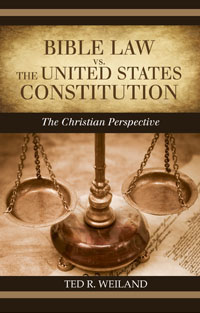
Click to order the Bible Law vs. The United States Constitution CDs:
- The e-book (on CD) A Christian Perspective on the U.S. Constitution
- The audio CD The Bible vs. The U.S. Constitution (Pts. 1 & 2)
End Notes
1. YHWH (most often pronounced Yahweh) is the English transliteration of the Tetragrammaton, the principal Hebrew name of the God of the Bible. For a more thorough explanation concerning the sacred names of God, "The Third Commandment" may be read online, or the book Thou shalt not take the name of YHWH thy God in vain may be ordered from Mission to Israel Ministries, PO Box 248, Scottsbluff, Nebraska 69363, for a suggested $4 donation.*
2. Where the Tetragrammaton (YHWH) - the four Hebrew characters that represent the personal name of God - has been unlawfully rendered the LORD or GOD in English translations, I have taken the liberty to correct this error by inserting YHWH where appropriate. For a more thorough explanation concerning the sacred names of God, "The Third Commandment" may be read online, or the book Thou shalt not take the name of YHWH thy God in vain may be ordered from Mission to Israel Ministries, PO Box 248, Scottsbluff, Nebraska, 69363, for a suggested $4 donation.*
3. All Scripture is quoted from the King James Version, unless otherwise noted. Portions of Scripture have been omitted for brevity. If you have questions regarding any passage, please study the text to ensure it has been properly used.
4. Not everyone claiming to be a Christian has been properly instructed in the Biblical plan of salvation. Mark 16:15-16; Acts 2:36-41, 22:1-16; Romans 6:3-4; Galatians 3:26-27; Colossians 2:11-13; and 1 Peter 3:21 should be studied to understand what is required to be covered by the blood of Jesus and forgiven of your sins. For a more thorough explanation concerning baptism and its relationship to salvation, the book Baptism: All You Wanted to Know and More may be requested from Mission to Israel Ministries, PO Box 248, Scottsbluff, Nebraska 69363, for free.
5. "antinomian ... a person who maintains that Christians are freed from the moral law by virtue of grace and faith." Random House Webster's College Dictionary, s.v. "antinomian" (New York, NY: Random House, 2000) p. 59.
6. Even many alleged pronomians are, at best, only two-thirds pronomian. They are interested in restoring Yahweh's commandments and statutes, but not His judgments. See Chapter 17 "Amendment 8: Bail, Fines, and Cruel and Unusual Punishments?" for additional information regarding Christian fear of Yahweh's judgments.
7. Not only do most "New Testament Christians" reject the law component of the New Covenant, they also either ignore or dismiss the importance of with whom Yahweh declared He would make His New Covenant. For a more thorough explanation regarding the who of the New Covenant, The Mystery of the Gentiles: Who Are They and Where Are They Now? may be read online, or the book may be ordered from Mission to Israel Ministries, PO Box 248, Scottsbluff, Nebraska, 69363, for a suggested $10 donation.*
8. Yeshua is the English transliteration of our Savior's given Hebrew name, with which He introduced Himself to the Apostle Paul in Acts 26:14-15. (Jesus is the English transliteration of the Greek Iesous, which is the Greek transliteration of the Hebrew Yeshua.) Because many people are unfamiliar or uncomfortable with Yeshua, I have chosen to use the more familiar Jesus in this book in order to remove what might otherwise be a stumbling block. For a more thorough explanation concerning the sacred names of God, "The Third Commandment" may be read online, or the book Thou shalt not take the name of YHWH thy God in vain may be ordered from Mission to Israel Ministries, PO Box 248, Scottsbluff, Nebraska 69363, for a suggested $4 donation.*
9. Biblical faith entails more than simply belief. Belief alone does not justify us. Mark 16:15-16; Acts 2:36-41, 22:1-16; Romans 6:3-4; Galatians 3:26-27; Colossians 2:11-13; and 1 Peter 3:21 should be studied in order to understand what is required to be covered by the blood of Jesus and forgiven of your sins. For a more thorough explanation concerning baptism and its relationship to salvation, Baptism: All You Wanted to Know and More may be requested from Mission to Israel Ministries, PO Box 248, Scottsbluff, Nebraska 69363, for free.
10. Kenneth L. Gentry, Jr., God's Law Made Easy: You Can Understand the Case for God's Law Today (Draper, VA: Aplogetics Group Media, 2010) p. 13.
11. Noah Webster, American Dictionary of the English Language, s.v. "licentiousness" (1828; reprint ed. San Francisco, CA: The Foundation for American Christian Education, 1967).
12. Samuel Bolton, The Moral Law: A Rule of Obedience, http://www.the-highway.com/articleFeb00.html.
13. Although Jasher is not a part of canonized Scripture, it is cited in Joshua 10:13 and 2 Samuel 1:18 and referenced in 2 Timothy 3:8.
14. "Romans 13 (Part 2)," The Voice of the Promised, April 2010, Special Edition, p. 1.
15. Gentry, pp. 11, 78.
16. Moore v. Strickling (1899) 46 W.Va. 515, 33 SE 274, 50 LRA 279, 282.
17. H.B. Clark, Clark's Biblical Law, Second Edition (Portland, OR: Binfords & Mort, 1943) p. 12.
18. See Chapter 6 "Article 3: Judicial Usurpation" for information regarding the Constitution's non-Biblical juridical system.
19. See Chapter 5 "Article 2: Executive Usurpation" for information regarding the Constitution's non-Biblical electoral system.
20. See Chapter 12 "Amendment 2: Constitutional vs. Biblical Self-Defense" for information regarding our Biblical responsibility to protect ourselves and others.
21. See Chapter 22 "Amendment 13: Constitutional vs. Biblical Slavery" for information regarding today's non-Biblical prison system.
22. See Chapter 25 "Amendment 16: Graduated Income Tax vs. Flat Increase Tax" for information regarding the unbiblical nature of the Constitutional Republic's tax system.
23. See Chapter 11 "Amendment 1: Government-Sanctioned Polytheism" for information regarding the constitutional provision for multiculturalism, pluralism, and polytheism.
24. John W. Welch, "Biblical Law in America: Historical Perspectives and Potentials for Reform," Brigham Young University Law Review 30 September 2002, p. 613, http://www.contra-mundum.org/essays/theonomy/WEL1.pdf.
25. Chuck Baldwin, "Can You Imagine This Country?" Chuck-Wagon Email Commentary, 10 July 2007, http://www.chuckbaldwinlive.com.
26. Benjamin Franklin, Ormond Seavey, ed., "Speech in the Constitutional Convention at the Conclusion of it Deliberations," Autobiography and Other Writings (Oxford: Oxford University Press, 1998) p. 350.
27. Rousas John Rushdoony, Sovereignty (Vallecito, CA: Ross House Books, 2007) p. v.
28. Clark, p. vii.
29. Hale v. Everett (1868) 53 NH 9, 16 AR 82, 191.
30. John Adams, Charles Francis Adams, ed., The Works of John Adams - Second President of the United States, 10 vols. (Boston, MA: Little, Brown & Co., 1854) vol. 9, p. 229.
31. I am employing the term "Constitutionalists" in reference both to those who are formal members of the Constitution Party and to anyone else who believes in and endorses the Constitution.
32. Mark A. Beliles and Douglas S. Anderson, Contending for the Constitution: Recalling the Christian Influence on the Writing of the Constitution and the Biblical Basis of American Law and Liberty (Charlottesville, VA: Providence Foundation, 2005) p. 99.
*In keeping with 2 Corinthians 9:7, this ministry is supported by freewill offerings. We are admonished in Matthew 10:8 that "freely ye have received, freely give." Therefore, we will be pleased to provide you with whatever you need for whatever you can send.
Click Here to Read Chapter 2