The judicial power of the United States, shall be vested in one supreme court, and in such inferior courts as the Congress may, from time to time, ordain and establish. The judges, both of the supreme and inferior courts, shall hold their offices during good behavior, and shall, at stated times, receive for their services a compensation, which shall not be diminished during their continuance in office.
Superior and Inferior Courts
Christian1 Constitutionalists generally believe the provision for a superior and inferior court system was derived from Jethro's counsel to Moses in Exodus 18:
Hearken now unto my voice, I will give thee counsel, and God shall be with thee: Be thou for the people to Godward, that thou mayest bring the causes unto God: And thou shalt teach them ordinances [statutes] and laws.... Moreover thou shalt provide out of all the people able men, such as fear God, men of truth, hating covetousness; and place such over them, to be rulers of thousands, and rulers of hundreds, rulers of fifties, and rulers of tens: And let them judge the people at all seasons: and it shall be, that every great matter they shall bring unto thee, but every small matter they shall judge: so shall it be easier for thyself, and they shall bear the burden with thee. (Exodus 18:19-22)2
This passage does provide Biblical precedent for a graduated judicial system, but that is where any similarity ends. The Bible stipulates, among other things, that judicial appointees must be men of truth who fear Yahweh and hate covetousness. (See Chapter 5 "Article 2: Executive Usurpation" for a list of additional Biblical qualifications.) The United States Constitution requires no Biblical qualifications whatsoever. Nowhere does the Constitution stipulate that judges must rule on behalf of Yahweh, rendering decisions based upon His commandments, statutes, and judgments as required in Exodus 18. That not even one constitutional framer contended for Yahweh,3 as did King Jehoshaphat, speaks volumes about the framers' disregard for Him and His judicial system:
And he [King Jehoshaphat] set judges in the land throughout all the fenced cities of Judah, city by city, and said to the judges, Take heed what ye do: for ye judge not for man, but for YHWH,4 who is with you in the judgment.... And he charged them, saying, Thus shall ye do in the fear of YHWH, faithfully, and with a perfect heart. (2 Chronicles 19:5-9)
In order for a court to be just, it must be impartial. For a court to be impartial, its judges must rule on behalf of Yahweh, instead of the state or any one class, gender, or person. Because constitutional government adjudicates on behalf of the state and the people, many rulings are unjust and adverse to Yahweh's morality:
...they have sinned against YHWH, the habitation of justice.... (Jeremiah 50:7)
R.J. Rushdoony described justices who do not represent Yahweh as political hacks:
If the judge does not represent God's Law order, he is ultimately a political hack and hatchet man whose job it is to keep the people in line, protect the establishment, and in the process to feather his own nest....5
...the judge was not to be an impartial referee but a partisan champion of the law of God, actively concerned with bringing God's justice to bear on every situation "by requiting the wicked, by recompensing his way upon his own head; and by justifying the righteous, by giving him according to his righteousness" (II Chron. 6:23).6
Anticipating their prohibition against Christian test oaths in Article 6, the framers could not require judges to fear Yahweh in Article 3. Yahweh's law requires judges to fear Yahweh; the Constitution bans the same qualification. The following decisions are only a small sampling of this rejection of Yahweh and His law and should not surprise anyone:
- 1962, Engel v. Vitale; Supreme Court finds prayer in schools unconstitutional.
- 1963, Abington v. Schempp; Supreme Court rules that Bible reading in public schools is unconstitutional.
- 1973, Roe v. Wade; Supreme court finds that the right to personal privacy includes infanticide.
- 1980, Stone v. Graham; Supreme court strikes down a Kentucky statute requiring display of the Ten Commandments in public schools.
- 2002, Newdow v. U.S.; 9th Circuit Court of Appeals rules that reciting "under God" in the Pledge of Allegiance in public schools is an unconstitutional endorsement of religion.
- 2003, Lawrence v. Texas; Supreme Court strikes down a Texas law prohibiting sodomy.
- 2003, Glassroth v. Moore; 11th Circuit Court of Appeals rules that a monument to the Ten Commandments placed in Alabama's judiciary building must be removed.
- 2003, Goodridge v. Department of Public Health; Massachusetts Supreme Court rules that same-sex couples can marry under the laws of that state.
- 2004, Massachusetts Supreme Court sanctions same-sex marriage; it declares that the state legislature may not offer "civil union" as an alternative to same-sex marriage, paving the way for the first state-recognized homosexual marriages in U.S. history.
- 2005, U.S. v. Extreme Associates; a U.S. district court judge dismisses federal obscenity charges against hardcore pornographers, finding that morality is no longer a legitimate state interest.
These court decisions are not the consequence of the courts' departure from the Constitution, but instead the consequence of the constitutional framers establishing a judiciary without specifying that it was to be governed by Yahweh's law. Because nothing requires constitutional judges to rule exclusively according to Yahweh's morality, they have tacit authority to adjudicate according to the immorality of Allah, Buddha, Krishna, Baal, or WE THE PEOPLE. This is especially true because of the polytheistic provision for freedom of religion in Amendment 1. Americans should prepare themselves for courts that rule according to Islamic Sharia and Jewish Beth Din laws, as is already occurring in England:
Islamic law has been officially adopted in Britain, with sharia courts given powers to rule on Muslim civil cases. The government has quietly sanctioned the powers for sharia judges to rule on cases ranging from divorce and financial disputes to those involving domestic violence. Rulings issued by a network of five sharia courts are enforceable with the full power of the judicial system, through the county courts or High Court....
Jewish Beth Din courts operate under the same provision in the Arbitration Act and resolve civil cases, ranging from divorce to business disputes. They have existed in Britain for more than 100 years....
Politicians and church leaders expressed concerns that this could mark the beginnings of a "parallel legal system" based on sharia for some British Muslims.7
Constitutional judges are required to render verdicts in agreement with the Constitution rather than the Bible anytime the two are in disagreement:
...when they ... find it [any law] to be incompatible with the superior power of the Constitution, it is their duty to pronounce it void.
James Wilson, Constitution Signatory and Supreme Court Justice8
James McHenry, a signatory of the Constitution and later Secretary of War, took what appears to have been a contrary position:
...the Holy Scriptures ... can alone secure to society, order and peace, and to our courts of justice and constitutions of government, purity, stability, and usefulness. In vain, without the Bible, we increase penal laws and draw entrenchments [defenses] around our institutions. Bibles are strong entrenchments. Where they abound, men cannot pursue wicked courses.9
Why then did McHenry sign his name to the Constitution? This is a classic case in which someone involved with the writing and ratification of the Constitution said the right things but did otherwise.
Good Behavior
The only qualification provided in Article 3 is that judges are to be men and women of good behavior:
Under Article III, Section 1, judges can only continue to hold their office "during good behavior," a broadly defined term that is meant to provide Congress with optimum discretionary authority. Unfortunately, Congress has only invoked this power twice in the last 210 plus years - once for drunkenness and once for disloyalty during the Civil War.10
Of what worth is a condition of good behavior if it is nowhere defined? In Mark 10:18, Jesus11 declared, "No one is good except God alone" (NASB). Good behavior can be defined and understood only from the parameters of Yahweh and His morality. Any standard that leaves "good behavior" to the determination of humans is humanism.
What the framers did was essentially the same as a father who tells his five-year-old son to be a good boy without explaining to him what is required of him to be good. When the son comes up with his own ideas about what qualifies as "good," the father has no grounds to discipline him. No wonder bad judges are so seldom disciplined and so difficult to remove from their benches.
Because all judges are lawyers and because lawyers have dominated every congress since 1789, the lawyers in the legislative branch are unlikely to turn on their fellow lawyers in the judicial branch. The majority of presidents have also been lawyers. So much for the purported separation of powers under the United States Constitutional Republic.
Section 2, Clauses 1-2
The judicial power shall extend to all cases, in law and equity, arising under this Constitution, the laws of the United States, and treaties made, or which shall be made, under their authority; to all cases affecting ambassadors, other public ministers, and consuls; to all cases of admiralty and maritime jurisdiction; to controversies to which the United States shall be a party....
In all cases affecting ambassadors, other public ministers and consuls, and those in which a state shall be party, the supreme court shall have original jurisdiction. In all the other cases before-mentioned, the supreme court shall have appellate jurisdiction, both as to law and fact, with such exceptions, and under such regulations as the Congress shall make.
The Supreme Court
There is hardly a political question in the United States which does not sooner or later turn into a judicial one.
Alexis de Tocqueville12
The Supreme Court, composed of one chief justice and eight associate justices, with its power to not only judge the facts of any case but also to interpret, judge, and overrule any "law" passed by Congress (what Gary North described as "retroactive legitimacy to legislation"13
), makes the Supreme Court the powerhouse or "big god" of this polytheistic system. Luther Martin, attorney-general of Maryland and one of Maryland's delegates to the Constitutional Convention, pointed out that the Supreme Court ultimately negates the jury system:
...in all cases where the general government has jurisdiction in civil questions ... its appellate jurisdiction, absolutely declares the Supreme Court shall have appellate jurisdiction both as to law and fact. Should, therefore, a jury be adopted in the inferior court, it would only be a needless expense, since, on an appeal, the determination of that jury, even on questions of fact, however honest and upright, is to be of no possible effect. The Supreme Court is to take up all questions of fact, to examine the evidence relative thereto, to decide upon them in the same manner as if they had never been tried by a jury.... But, Sir, the appellate jurisdiction extends ... to cases criminal as well as to civil; and, on the appeal, the court is to decide not only on the law, but on the fact. If, therefore, even in criminal cases, the general government is not satisfied with the verdict of the jury, its officer may remove the prosecution to the Supreme Court, and there the verdict of the jury is to be of no effect, but the judges of this court are to decide upon the fact as well as the law....14
The power of the people of the United States of America and their representatives is subject to the Judicial Branch, and ultimately the Supreme Court, which is essentially immune from any kind of censure. The real power or sovereignty of the United States Constitutional Republic resides in a Biblically unqualified and nearly always Biblically adverse five to four majority. The United States government is ultimately under the control and direction of five lawyers. And why not? In 1787, it was predominately lawyers (thirty-four of the fifty-five delegates were lawyers) who framed the Constitution and gave ultimate power into the hands of their own trade. Concerning public opinion in 1787, Forrest McDonald wrote that "few Americans except lawyers trusted a truly independent judiciary."15
North observes that "political conservatives cry out against the concentration of power in the hands of the Supreme Court."16
But this is only because the Supreme Court's rulings are predisposed toward liberals. If it were otherwise, political conservatives would have no objections against this concentration of power.
The Supreme Legislator
In the United States, rights are proclaimed in the Constitution, but they are defined by the Supreme Court, which the Constitution has established to provide a reliable and definitive interpretation of the law.17
Although Article 6 declares the Constitution the supreme law of the land, whoever has the power to interpret that law is the supreme legislator. Chief Justice Warren Burger commented on the landmark case Marbury v. Madison (1803), which established judicial review under Article 3 of the Constitution:
The cornerstone of our constitutional history and system remains the firm adherence of the Supreme Court to the Marbury principle of judicial review that "someone must decide" what the Constitution means.18
James Madison concurred:
I acknowledge, in the ordinary course of government, that the exposition of the laws and Constitution devolves upon the Judiciary.19
Supreme Court Associate Justice Charles Evan Hughes commented upon this inescapable fact:
Article VI of the Constitution makes the Constitution the "supreme Law of the Land." ...[But it] is emphatically the province and duty of the judicial department to say what the law is.... It follows that the interpretation of the [Constitution] enunciated by this Court ... is the supreme law of the land....20
Constitutionalists may protest, but it was inevitable that the Supreme Court would dominate the Constitutional Republic's three branches.
The court does not merely interpret the rules; it expands them, as indeed it must in view of their cryptic incisiveness and the ever-multiplying and changing nature of the confrontations between religion and government which the court must resolve.... On occasion the court must even rewrite the rules.
In short, while the Constitution provides formal methods for its amendment, the Supreme Court can be considered a de facto continuing convention expanding or rewriting the Constitution as the need arises....21
In other words, the Constitution is whatever the Supreme Court - at any given time - says it is.
How paradoxical that the first nation to base its political philosophy on the principle that all political authority derives from the people, and that the people express their will through elected representatives, should also be the first to embrace the principle that the ultimate interpretation of the validity of the popular will should be lodged not in the people themselves, or in their representatives, but in one non-elected and, therefore, non-democratic branch of the government.22
Without God's word as our anchor for law, we are ultimately governed by activist judges and their judicial whims. Under that standard, law is manipulated to correspond ... to what the judges think it should say rather than what it actually says.... Law becomes whatever a few elitist judges say it is....23
Thomas Jefferson and George Mason were prophetic in their comments about the judiciary:
The constitution ... is a mere thing of wax in the hands of the judiciary, which they may twist and shape into any form they please.24
It has long, however, been my opinion, and I have never shrunk from its expression ... that the germ of dissolution of our federal government is in the constitution of the federal Judiciary ... working like gravity by night and by day, gaining a little to-day and a little to-morrow, and advancing its noiseless step like a thief, over the field of jurisdiction, until all shall be usurped....25
The Judiciary of the United States is so constructed and extended, as to absorb and destroy the Judiciaries of the several States; thereby rendering Law as tedious, intricate, and expensive, and Justice as unattainable, by a great part of the Community, as in England, and enabling the Rich to oppress and ruin the poor.26
Under Yahweh's law, such a judiciary would be considered treasonous. At the very least, any judges involved in such treason would be removed from the bench.
Woe unto them that decree unrighteous decrees, and that write grievousness which they have prescribed; to turn aside the needy from judgment, and to take away the right from the poor of my people, that widows may be their prey, and that they may rob the fatherless! (Isaiah 10:1-2)
The United States constitutional juridical system is disposed toward the wealthy and often wrests judgment from the poor. The scales are tipped in favor of the rich simply because the average person cannot afford the same quality and quantity of attorneys as a wealthy man. This, in itself, is a type of unjust weights and measures. Money and attorney gamesmanship - not justice - rule today's courts, and the result, all too often, is the plundering of the innocent:
This is one of the problems inherent in an adversarial system [such as with the United States juridical system], rather than an advocacy system in which there is a concern on the part of all to arrive at truth. Defense attorneys are concerned only with acquittal of their defendants rather than simply ensuring that they get a fair trial. Instead of emphasizing a judgment based on the full disclosure of evidence, an adversarial system focuses on who can best present their case. Elocution triumphs over truth.
Almost everyone can cite a horror story of an acquaintance who has been sued for frivolous reasons, was subsequently acquitted, but ended up with a $10,000 attorney bill. Is this justice? ...[J]ustice in the United States is no longer blind, it is cross-eyed.27
Yahweh demands equity in His courts for poor and wealthy alike:
Neither shalt thou countenance a poor man in his cause.... Thou shalt not wrest the judgment of thy poor in his cause. Keep thee far from a false matter.... And thou shalt take no gift [bribe, NASB]: for the gift blindeth the wise, and perverteth the words of the righteous. (Exodus 23:3-8)
Attorney fees are often nothing more than bribes to acquit the guilty.
Inherently Flawed
Constitutionalists believe the superiority of the United States juridical system is demonstrated in that even Supreme Court decisions can be overturned and made right by either future Supreme Court justices or by constitutional amendment. But history has proven the opposite is more likely. Furthermore, the injustices that often occur in the interim between a bad decision and a better decision would seldom, if ever, occur in a Biblical court.
Nothing demonstrates this fundamental defect better than Roe v. Wade, which constitutionally has provided for an endless number of infants to be murdered. While Christian Constitutionalists wait for the Constitutional Republic's system to (they hope) correct itself, millions more infants are being murdered. Under Yahweh's law, not one infant would have been murdered.
Even when wrong decisions are overturned, they can be overturned again by a later court. Judicial records expose this capricious tendency of the United States juridical system:
...law not founded upon absolutes is very dangerous to society. Consider that without absolutes, the Supreme Court has reversed itself over 100 separate times!28
The actual number is more than double this figure:
The Court had reversed itself in 219 cases by 2000. Of this total, all but seven instances came after the Civil War. All but 28 came after 1913. Over 60 percent came after 1941. This process is accelerating.29
Judicial "standards now change as rapidly as the Justices. This causes an uncertainty for society; and, in fact, often establishes a dubious standard which, in effect, is no standard at all."30 Unlike the Bible, the Constitution is not an infallible standard. Returning to a more "pure" constitutionalism is not the answer. The answer is found in returning to Yahweh's perfect law and altogether righteous judgments.
Appellate System
Unlike the Constitutional Republic, Yahweh's court system has no litigant appellate process. In Exodus 18, difficult cases were turned over to higher judges (over fifties, hundreds, and thousands) and finally to Moses by lower courts, not for appeal, but for adjudication. Appellate systems such as provided by Article 3 only delay judgments. Without Yahweh's morality as the standard, higher courts have no better chance of arriving at a just decision than do lower courts.
Lawyers
This chapter would be incomplete without something being said regarding lawyers, who, as pointed out earlier, have predominated all three branches of the Constitutional Republic from the onset and who have only become more entrenched since its ratification:
Whenever lawyers dominate a society - usually during the society's final years - they steadily substitute formal procedure for ethics.... They adopt a theology of salvation by law, or at least continued employment by law. The practice of law replaces the law itself; "law" becomes case laws, precedents, and procedures, but without any thought or hope concerning an integrated law-order that provides meaning to the law in general. Law becomes what men say it is, and men do not agree. Humanism's implicit judicial polytheism then leads to the disintegration of civil law: jammed courts, endless litigation, plea bargaining, and all the other aspects of twentieth-century judicial tyranny that we have become numbed into accepting as normative.
The Bible is concerned with ethics, not formal courtroom procedure.... It is the mark of a culture in the process of disintegration that it substitutes procedure for ethics, the letter of its law for the spirit of its law. Even more important is the bureaucratic machinery that defines the letter of the law.... Techniques of judicial interpretation are considered more fundamental than the substance of the law. Such an attitude invariably transfers authority from the people to a self-certified elite, the interpreters. It creates a secular priesthood.31
The most consequential repercussion of the Constitutional Republic's juridical system was its effect upon the church:
The church ... was thrown out into the street by the lawyers of Philadelphia, who decided not to have a Christian country.... [I]n effect, they took all the promises of religion, the pursuit of happiness, safety, security, all kinds of things, and they set up a lawyers' paradise, and the church was disenfranchised totally.32
Consider Jesus' denunciation of lawyers:
Woe unto you, lawyers! For ye have taken away the key of knowledge: ye entered not in yourselves, and them that were entering in ye hindered. (Luke 11:52)
The key of knowledge is the law of Yahweh, and lawyers, including and especially the Philadelphia thirty-four, have altered that law:
My people are destroyed for lack of knowledge: because thou hast rejected knowledge, I will also reject thee ... seeing thou hast forgotten the law of thy God.... (Hosea 4:6)
Section 2, Clause 3
The trial of all crimes, except in cases of impeachment, shall be by jury; and such trial shall be held in the state where the said crimes shall have been committed; but when not committed within any state, the trial shall be at such place or places as the Congress may by law have directed.
The Unbiblical Jury System
Article 3's provision for juries is yet another instance of the framers' deciding they knew better than Yahweh. The Bible offers nothing that resembles a jury system. In an attempt to make the Constitution's jury system appear Biblical, one pastor wrote:
The jury was not invented by human minds but is a system that came from God through His Israel people. Deu 1:22 "And ye came near unto me every one of you, and said, We will send men before us, and they shall search us out the land, and bring us word again by what way we must go up, and into what cities we shall come. 23 And the saying pleased me well: and I took twelve men of you, one of a tribe."33
Deuteronomy 1:22-23 has nothing to do with a jury system. It provides the account of Moses' sending one man from each of the twelve tribes to spy out Canaan. If this is a precedent for a jury system, it is a poor one because ten of the twelve "jurors" came back with the wrong verdict.
In their attempt to make the Constitution Biblical, Mark Beliles and Douglas Anderson maintain "the right of ‘trial by jury'" was "set forth in the Bible in Deuteronomy 19:15-19."34 This passage cites priests and judges but says nothing about juries:
One witness shall not rise up against a man for any iniquity, or for any sin, in any sin that he sinneth: at the mouth of two witnesses, or at the mouth of three witnesses, shall the matter be established. If a false witness rise up against any man to testify against him that which is wrong; then both the men, between whom the controversy is, shall stand before YHWH, before the priests and the judges, which shall be in those days; and the judges shall make diligent inquisition: and, behold, if the witness be a false witness, and hath testified falsely against his brother; then shall ye do unto him, as he had thought to have done unto his brother: so shalt thou put the evil away from among you. (Deuteronomy 19:15-19)
Most Constitutionalists favor the jury system, provided jury nullification (a juror's right to judge a law as unjust, oppressive, or inapplicable to any particular case) is in force. However, even if jury nullification were restored, juries would still render decisions based upon each jury's collective standard of morality or immorality. "A jury drawn from the [Biblically] uninstructed population is no better equipped to administer the just requirements of God's law than a corrupt judge."35 A jury awarded $2.3 million to Stella Liebeck when she burned herself with McDonald's coffee, and a jury found O.J. Simpson innocent on all charges. Although it might be argued that it only takes one juror to dissent and prevent a "railroad job," most people lack the independence and resolution to resist the will of a majority. More often than not, today's jurors reflect the type of people we are warned against in Exodus 23:
Thou shalt not follow a multitude to do evil; neither shalt thou speak in a cause to decline after many to wrest judgment. (Exodus 23:2)
Juries produce, at best, erratic justice. Without Yahweh's law as the standard, jury decisions are based upon the capricious morality of its members. Nothing demonstrates this better than Jesus' trial by a jury of His peers with Pontius Pilate presiding. The prevailing immorality of the day demanded Jesus be crucified even though He was clearly innocent.
The character of the courts, judges, and legal system cannot be long maintained if the character of the people is delinquent and degenerate. Courts and judges do not exist in a vacuum: they are part of the faith, culture, and moral standards of the people at large, of the nation of which they are a part.36
And there shall be, like people, like priest: and I will punish them for their ways.... (Hosea 4:9)
The constitutional right of a trial by a jury of "impartial" peers is regarded by Americans - especially Christian Constitutionalists - as one of the last bulwarks against tyranny. If this is true, Yahweh (who is unquestionably a God of justice and liberty) would have included juries somewhere in His perfect law and righteous judgments. Surely, one of the reasons He did not provide for them is that juries (like elections) place government policy and juridical determinations in the hands of an unpredictable and unequally yoked public, the majority of whom are not Christian (Matthew 7:13).
Biblical Judges
Although the following passages provide for judges, officers, and magistrates, the Bible nowhere mentions juries:
...thou shalt provide out of all the people able men, such as fear God, men of truth, hating covetousness.... And let them judge the people at all seasons.... (Exodus 18:20-22)
For all manner of trespass ... the cause of both parties shall come before the judges.... (Exodus 22:9)
And I charged your judges ... saying, Hear the causes between your brethren, and judge righteously between every man and his brother, and the stranger that is with him. (Deuteronomy 1:16)
Judges and officers shalt thou make thee in all thy gates ... and they shall judge the people with just judgment. (Deuteronomy 16:18)
If there be a controversy between men, and they come unto judgment, that the judges may judge them; then they shall justify the righteous, and condemn the wicked. (Deuteronomy 25:1)
And thou, Ezra, after the wisdom of thy God, that is in thine hand, set magistrates and judges ... all such as know the laws of thy God.... (Ezra 7:25)
When a judicial system is governed by Biblically qualified judges - whose decisions are based upon Yahweh's commandments, statutes, and judgments - juries are unnecessary. Under such a system, all judicial decisions reflect Yahweh's never-changing morality. In Deuteronomy 25:1, Yahweh admonished judges to "justify the righteous, and condemn the wicked." Where is this most likely to occur - in the courts of sinners or in the courts of the saints? Do not look for it in the courts of the unrighteous:
Her princes within her are roaring lions; her judges are evening wolves ... they have done violence to the law. (Zephaniah 3:3-4)
Constitutional justices, such as Antonin Scalia, make no apologies for (allegedly) separating their religious beliefs from their judicial decisions, as required in Article 6:
Scalia ... said his job is only to determine the intent of the Constitution's framers, not to contort the text to fit his religious beliefs. He said he opposes Roe v. Wade not on theological grounds but because he can find no reference to abortion in the Constitution. "The reality is that the Constitution says nothing about abortion either way and the states are therefore allowed to permit it or to prohibit it," he said.
Scalia frequently referred to himself ... as a [Constitution] "textualist," and reminded his mostly Catholic audience that they should not wish for judges who meld religion with their work. "If it's proper for Catholic judges to do that, it's proper for atheistic judges, for secularistic judges, for judges opposed to all Christian and religious beliefs, to do the same thing," Scalia said.37
All judicial decisions are based upon the judge's moral values, which shape his ethics and are, therefore, religious. Today's unbiblical judges create laws based upon their own values, and these rulings become the binding precedents, called case law, that compel juries to render decisions accordingly.
In an article entitled "...And Justice for None," Paul Craig Roberts (former Assistant Secretary of Treasury under President Reagan) expounded upon some of the inherent problems in today's juridical system:
The United States has the highest rate of incarceration in the world and imprisons 6 to 10 times as many people as any other industrialized country. Between 1990 and 2000, the U.S. population increased 13 percent. The U.S. prison population more than tripled.
There are hundreds of thousands of innocent Americans in prison. They are there because the criminal justice system no longer works to discover the truth of a crime, but to convict at all cost whoever happens to be charged with a crime. And they are there because the United States criminalizes more acts than any other country in the world, including tyrannical police states....
Almost everyone in prison is wrongfully convicted, even the guilty. According to the Department of Justice, 95 percent of criminal convictions result from plea bargains. What is a plea bargain but self-incrimination, conviction without a trial by jury and without a test of the evidence against the defendant?
An uninformed public believes plea bargains to be sweet deals for criminals. Sometimes they are, but more often, pleas result from prosecutors piling on charges until the defendant, innocent or guilty, cries "uncle" and gives up.38
Is it merely coincidence that the United States also has the highest number of lawyers per capita - one in every 265 citizens?
Christian Courts
Because the judicial system of first-century Rome was also corrupt, the Apostle Paul admonished Christians to set up their own courts of law:
Dare any of you, having a matter against another, go to law before the unjust, and not before the saints? Do ye not know that the saints shall judge the world? And if the world shall be judged by you, are ye unworthy to judge the smallest matters? Know ye not that we shall judge angels? How much more things that pertain to this life?... Is it so, that there is not a wise man among you? No, not one that shall be able to judge between his brethren? But brother goeth to law with brother, and that before the unbelievers. Now therefore there is utterly a fault among you, because ye go to law one with another. Why do ye not rather take wrong? Why do ye not rather suffer yourselves to be defrauded? (1 Corinthians 6:1-7)
When expounding upon this text, preachers usually emphasize the last verse to the exclusion of everything else. However, verse 7 cannot be properly understood if robbed of its context. Paul is saying that Christians should maintain their own judicial system and, if they cannot find a wise man among themselves to judge between them, it is better to be defrauded than to be judged by infidels. This is essentially the same thing Jesus declared:
Agree with thine adversary quickly, whiles thou art in the way with him; lest at any time the adversary deliver thee to the judge, and the judge deliver thee to the officer, and thou be cast into prison. Verily I say unto thee, Thou shalt by no means come out thence, till thou hast paid the uttermost farthing. (Matthew 5:25-26)
Anything less than a Christian court system, governed by Yahweh's commandments, statutes, and judgments and adjudicated by Biblically qualified judges, fails Paul's criteria. The courts Paul described were to begin with Christians judging Christians, with the objective of someday judging the world:
Do ye not know that the saints shall judge the world? And if the world shall be judged by you, are ye unworthy to judge the smallest matters [among yourselves]? ...How much more things that pertain to this life? (1 Corinthians 6:2-3)
This is referring to this age, here on earth:
And we are ready to punish all disobedience, whenever your obedience is complete. (2 Corinthians 10:6, NASB)
This verse is usually interpreted as referring to disobedience in the church. But why would Paul delay punishment of disobedient Christians until they were obedient? Why would he wait to punish their sin until after they had repented? Instead, Paul is referring to a future time when the Christian community would be powerful enough to influence and even control government policy, including the judgment and punishment of the wicked. This is also borne out in Romans 13, in which the Greek word ékdikos (from which "punish" in 2 Corinthians 10:6 is derived) is translated "a revenger":
For rulers [judges, Exodus 18:21-22] are not a terror to good works, but to the evil. Wilt thou then not be afraid of the power? Do that which is good, and thou shalt have praise of the same: For he is the minister of God to thee for good. But if thou do that which is evil, be afraid; for he beareth not the sword in vain: for he is the minister of God, a revenger to execute wrath upon him that doeth evil. Wherefore ye must needs be subject, not only for wrath, but also for conscience sake. (Romans 13:3-5)
Like 1 Corinthians 6, Romans 13 describes a Christian body politic that metes out Yahweh's judgments upon the wicked.39 Romans 13 and 2 Corinthians 10 are first and second witnesses to Paul's instruction in 1 Corinthians 6, charging the Christian community to set up their own judicial system. 1 Timothy 1 offers a third witness:
But we know that the law is good, if a man use it lawfully; knowing this, that the law [its judgment] is not made for a righteous man, but for the lawless and disobedient, for the ungodly and for sinners, for unholy and profane, for murderers of fathers and murderers of mothers, for manslayers, for whoremongers, for them that defile themselves with mankind, for menstealers, for liars, for perjured persons, and if there be any other thing that is contrary to sound doctrine; according to the glorious gospel of the blessed God, which was committed to my trust. (1 Timothy 1:8-11)
Modern Christianity has ignored these instructions, content to let non-Christians and even antichrists rule and administer unrighteous judgments. In Lamentations 5:14, Jeremiah lamented that "the elders [the judges] have ceased from the gate [where court was convened]." (See Chapter 17 "Amendment 8: Bail, Fines, and Cruel and Unusual Punishments" for information regarding Christian fear of Yahweh's judgments.) Christianity has become saltless and good for nothing but to be trampled under the foot of man, which, among other things, means being judged by man's standards in man's courts. This is precisely the opposite of what we find described by Solomon: "The evil bow before the good; and the wicked at the gates [where court was convened] of the righteous." (Proverbs 14:19)
At an earlier time in America, Christendom controlled the body politic and administered Yahweh's judgments. The Colony of New Haven, Connecticut used 1 Corinthians 6:1 and 6:6-7 to justify doing so. Leonard Bacon (1802-1881) wrote the following concerning New Haven's 1639 judicial system:
Notice ... how great a change, in respect to the inflicting of capital punishments was made by adopting the Hebrew laws, instead of the laws of England. By the laws of England, more than one hundred and fifty crimes were till quite lately, punishable with death. By the laws which the New England colonists adopted, this bloody catalogue was reduced to eleven [murder, treason, perjury against the life of another, kidnapping, bestiality, sodomy, adultery, blasphemy in the highest degree, idolatry, witchcraft, and rebellion against parents].... The greatest and boldest improvement which has been made in criminal jurisprudence, by any one act, since the dark ages, was that which was made by our [Colonial] fathers, when they determined, "that the judicial laws of God, as they were delivered by Moses, and as they are a fence to the moral law ... shall be accounted of moral equity, and generally bind all offenders, and be a rule to all the courts."40
If the framers intended the Constitution to represent Yahweh, they would have set up the Judicial Branch to resemble that of the New Haven Colony. The Judicial Branch provided for in Article 3 is not equivalent to that provided for in the Bible. It is the consequence of the framers' rejection of Romans 13:1-7, 1 Corinthians 6:1-6, 2 Corinthians 10:4-6, and 1 Timothy 1:8-11.
Section 3, Clause 1
Treason against the United States shall consist only in levying war against them, or in adhering to their enemies, giving them aid and comfort. No person shall be convicted of treason unless on the testimony of two witnesses to the same overt act, or on confession in open court.
Treason
That the framers were not concerned with treason against Yahweh proves by itself their government was not Biblical. In fact, because treason is a crime against sovereignty, the Constitutional Republic established in 1789 was itself a treasonous act against Yahweh and His government. Two sovereigns cannot coexist. When the framers established the United States government as sovereign, they became guilty of First and Second Commandment treason against Yahweh.
Two Witnesses
Section 3, Clause 1 requires two witnesses only to the crime of treason. Deuteronomy 19:15 requires two or more witnesses in all criminal cases:
One witness shall not rise up against a man for any iniquity, or for any sin, in any sin that he sinneth: at the mouth of two witnesses, or at the mouth of three witnesses, shall the matter be established. (Deuteronomy 19:15)
If Deuteronomy 19:15 was the inspiration for the two-witness requirement of Section 3, this is but another instance of the framers compromising Yahweh's law.
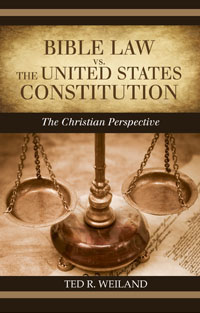
Click to order the Bible Law vs. The United States Constitution CDs:
- The e-book (on CD) A Christian Perspective on the U.S. Constitution
- The audio CD The Bible vs. The U.S. Constitution (Pts. 1 & 2)
End Notes
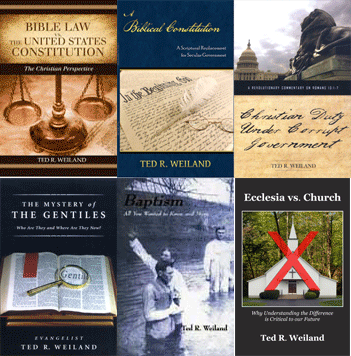
1. Not everyone claiming to be a Christian has been properly instructed in the Biblical plan of salvation. Mark 16:15-16; Acts 2:36-41, 22:1-16; Romans 6:3-4; Galatians 3:26-27; Colossians 2:11-13; and 1 Peter 3:21 should be studied to understand what is required to be covered by the blood of Jesus and forgiven of your sins. For a more thorough explanation concerning baptism and its relationship to salvation, the book Baptism: All You Wanted to Know and More may be requested from Mission to Israel Ministries, PO Box 248, Scottsbluff, Nebraska 69363, for free.
2. All Scripture is quoted from the King James Version, unless otherwise noted. Portions of Scripture have been omitted for brevity. If you have questions regarding any passage, please study the text to ensure it has been properly used.
3. YHWH (most often pronounced Yahweh) is the English transliteration of the Tetragrammaton, the principal Hebrew name of the God of the Bible. For a more thorough explanation concerning the sacred names of God, "The Third Commandment" may be read online, or the book Thou shalt not take the name of YHWH thy God in vain may be ordered from Mission to Israel Ministries, PO Box 248, Scottsbluff, Nebraska 69363, for a suggested $4 donation.*
4. Where the Tetragrammaton (YHWH) - the four Hebrew characters that represent the personal name of God - has been unlawfully rendered the LORD or GOD in English translations, I have taken the liberty to correct this error by inserting YHWH where appropriate. For a more thorough explanation concerning the sacred names of God, "The Third Commandment" may be read online, or the book Thou shalt not take the name of YHWH thy God in vain may be ordered from Mission to Israel Ministries, PO Box 248, Scottsbluff, Nebraska, 69363, for a suggested $4 donation.*
5. Rousas John Rushdoony, The Institutes of Biblical Law (The Presbyterian and Reformed Publishing Company, 1973) p. 613.
6. Ibid., p. 625.
7. Abul Taher, "Revealed: UK's first official sharia courts," TIMESONLINE, 14 September 2008, http://www.timesonline.co.uk/tol/news/uk/crime/article4749183.ece.
8. James Wilson, at the Pennsylvania Ratification Debates on Saturday, December 1, 1787, Debates in the Several State Conventions on the Adoption of the Federal Constitution, Jonathan Elliot, ed., 5 vols. (Washington, DC: Printed for Jonathan Elliot, 1836) vol 2, p. 446.
9. James McHerny, quoted in Bernard C. Steiner, One Hundred and Ten Years of Bible Society Work in Maryland, 1810-1920 (Baltimore, MD: The Maryland Bible Society, 1921) p. 14.
10. Mark A. Beliles, Douglas S. Anderson, Contending for the Constitution: Recalling the Christian Influence on the Writing of the Constitution and the Biblical Basis of American Law and Liberty (Charlottesville, VA: Providence Foundation, 2005) p. 149.
11. Yeshua is the English transliteration of our Savior's given Hebrew name, with which He introduced Himself to Paul in Acts 26:14-15. (Jesus is the English transliteration of the Greek Iesous, which is the Greek transliteration of the Hebrew Yeshua.) Because many people are unfamiliar or uncomfortable with Yeshua, I have chosen to use the more familiar Jesus in this book in order to remove what might otherwise be a stumbling block. For a more thorough explanation concerning the sacred names of God, "The Third Commandment" may be read online, or Thou shalt not take the name of YHWH thy God in vain may be ordered from Mission to Israel Ministries, PO Box 248, Scottsbluff, Nebraska 69363, for a suggested $4 donation.*
12. Alexis de Tocqueville, Democracy in America and Two Essays on America (London, UK: Penguin Books Ltd., 2003) p. 315.
13. Gary North, Political Polytheism: The Myth of Pluralism (Tyler, TX: Institute for Christian Economics, 1989) p. 502.
14. Luther Martin, "The Genuine Information, Laid Before The Legislature Of Maryland...," Secret Proceedings and Debates of the Constitutional Convention 1787, Entered according to Act of Congress, in the year 1838 (Hawthorne, CA: Omni Publications, 1986) pp. 80-81.
15. Forrest McDonald, Novus Ordo Seclorum: The Intellectual Origins of the Constitution (Lawrence, KS: University Press of Kansas, 1985) p. 85.
16. Gary North, Conspiracy in Philadelphia: The Broken Covenant of the U.S. Constitution (Draper, VA: Nicene Council.com, 2004) p. 274.
17. International Information Programs, USINFO.STATE.GOV, "Religious Liberty in the Modern Era," Rights of the People: Individual Freedom and the Bill of Rights, http://uninfo.state.gov/products/pubs/rightsof/modern.htm.
18. Chief Justice Warren E. Burger, Introduction, William Swindler, The Constitution and Chief Justice Marshall (New York, NY: Dodd, Mead & Company, 1978) p. xiii.
19. James Madison, June 17, 1789, The Debates and Proceedings in the Congress of the United States (Washington, DC: Gales and Seaton, 1834) vol. 1, p. 520.
20. Cooper v. Aaron, 358, U.S. 1 (1958).
21. Leo Pfeffer, God, Caesar, and The Constitution: The Court as Referee of Church-State Confrontation (Boston, MA: Beacon Press, 1975) pp. 30-31.
22. Henry Steele Commager, The Empire of Reason: How Europe Imagined and American Realized the Enlightenment (New York, NY: Anchor Press/Doubleday, 1977) p. 229.
23. Beliles, Anderson, pp. 138-39.
24. Thomas Jefferson, H.A. Washington, ed., The Writings of Thomas Jefferson, 9 vols. (Washington DC: Taylor & Maury, 1854) vol. 8, p. 134.
25. Thomas Jefferson, Andrew A. Lipscomb, ed., The Writings of Thomas Jefferson, 20 vols. (Washington, DC: The Thomas Jefferson Memorial Association of the United States, 1905) vol. 15, pp. 331-32.
26. George Mason, David Wootten ed., The Essential Federalist and Anti-Federalist Papers (Indianapolis, IN: Hackett Publishing Company, 2003) pp. 1-2.
27. Dennis Woods, Discipling the Nations: The Government Upon His Shoulder (Franklin, TN: Legacy Communications, 1996) pp. 83-85.
28. Beliles, Anderson, p. 146.
29. Gary North, Conspiracy in Philadelphia, p. 278.
30. David Barton, Original Intent: The Courts, the Constitution, & Religion (Aledo, TX: Wallbuilder Press, 2005) p. 233.
31. Gary North, Tools of Dominion: The Case Laws of Exodus (Tyler, TX: The Institute for Christian Economics, 1990, 1997) p. 107.
32. Otto Scott, "Easy Chair" audiotape #165 (March 10, 1988) distributed by Chalcedon Foundation, P.O. Box 158, Vallecito, CA 95251, quoted in Gary North, Political Polytheism: The Myth of Pluralism (Tyler, TX: Institute for Christian Economics, 1989) p. 675.
33. Everett Ramsey, America Today (Houston, MO: America Today Publishers) October, 1995.
34. Beliles, Anderson, p. 145.
35. Dennis Oliver Woods, A Handbook of Biblical Law (Prepublication, 2010) p. 12.
36. Rushdoony, p. 639.
37. Mary Claire Dale, "Scalia Speaks at Villanova University," 16 October 2007, Associated Press, http://abclocal.go.com/wpvi/story?section=news/local&id=5710943.
38. Paul Craig Roberts, "...And Justice for None," American Free Press, 16 February 2004.
39. Christian Duty Under Corrupt Government: A Revolutionary Commentary on Romans 13:1-7 may be ordered from Mission to Israel Ministries, PO Box 248, Scottsbluff, Nebraska 69363, for a suggested $7 donation.*
40. Leonard Bacon, Thirteen Historical Discourses, on the Completion of Two Hundred Years, From the Beginning of the First Church in New Haven, With an Appendix (New Haven, CT: Durrie & Peck, 1839) p. 32.
*We are admonished in Matthew 10:8 "freely ye have received, freely give." Although we have a suggested a price for our books, we do not sell them. In keeping with 2 Corinthians 9:7, this ministry is supported by freewill offerings. If you cannot afford the suggested price, inform us of your situation, and we will be pleased to provide you with whatever you need for whatever you can send.